Mountain bike hydration packs have to do two jobs at once: keep water flowing on rough descents without sloshing or bouncing, and carry your tools, layers, and snacks without turning into a sweaty burden. After comparing ten of the most popular options for 2026, the Osprey Raptor 14 stands out as the best overall pick thanks to its superb Hydraulics reservoir, stable ride, and enough cargo room for all-day trail missions. The CamelBak M.U.L.E. 12 is the strongest challenger for riders who want a tighter, more minimalist fit, while the budget-friendly CamelBak Hydrobak wins for short laps where storage barely matters. The main tradeoff in this category is capacity versus comfort: bigger packs like the Teton Oasis carry more but run hotter and bounce more on technical terrain. Read on for the full breakdown of all ten packs.

Get sports gear delivered free — and shop member deals
- Fast, free delivery on millions of items
- Access to Prime Big Deal Days deals on October 6–7
- Prime Video, Amazon Music and more included
Complete the kit


Key Takeaways
- Osprey‘s Hydraulics reservoir system was the clearest quality separator in this lineup — its rigid backplate and magnetic bite valve made cheaper bladders feel like an afterthought.
- CamelBak dominates the value end: the Hydrobak and Classic deliver dependable leak-free hydration at half the price of premium packs, but with noticeably less cargo organization.
- Capacity bands matter more than brand: 9–12L packs (Raptor 10, M.U.L.E. 12) rode the most stable on technical descents, while 18L+ packs (Everfun, Teton Oasis) shifted and ran hotter.
- Multi-sport packs like the Unigear and Everfun cost less than bike-specific models, but their generic fit lacks the ventilated back panels and helmet-specific storage dedicated MTB packs offer.
- The Blue Quartz and Teton packs proved that a 2L–3L bladder included in the price is now standard even under $50 — paying more should buy fit and durability, not just water capacity.
| Osprey Raptor 14L Men’s Mountain Biking Backpack with Hydraulics Reservoir |  | Best Overall | Total Capacity: 14L | Reservoir: 2.5L Hydraulics | Harness: Winged, bike-specific fit | VIEW LATEST PRICE | See Our Full Breakdown |
| Unigear Hydration Pack Backpack with 2L Water Bladder for Hiking & Cycling | 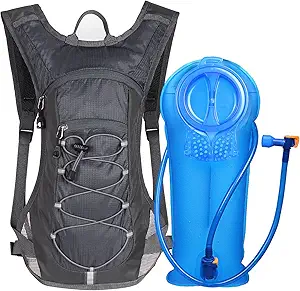 | Best Value | Water Capacity: 2 liters | Bladder Material: BPA-free | Shell Material: 100% nylon, splash-resistant | VIEW LATEST PRICE | See Our Full Breakdown |
| CamelBak Hydrobak Hydration Reservoir Bike Pack |  | Best for Short Rides | Reservoir Capacity: 50oz Crux | Design: Lightweight, compact | Back Panel: Air mesh, breathable | VIEW LATEST PRICE | See Our Full Breakdown |
| Teton Oasis/Trailrunner Hydration Backpack – Lightweight Water Pack with 2L/3L Bladder |  | Best for Weather and Capacity | Water Capacity: 2L or 3L bladder | Storage Capacity: 18L or 22L | Insulation: Insulated bladder sleeve | VIEW LATEST PRICE | See Our Full Breakdown |
| Blue Quartz Hydration Backpack with 2L Water Bladder for Outdoor Activities |  | Best for Warm-Weather Comfort | Water Capacity: 2L | Bladder Material: BPA-free | Insulation: Insulated bladder compartment | VIEW LATEST PRICE | See Our Full Breakdown |
| CamelBak M.U.L.E. 12 Mountain Bike Hydration Pack |  | Best Overall | Capacity: 12 liters | Reservoir Capacity: 100 oz | Back Panel: Air Support ventilation | VIEW LATEST PRICE | See Our Full Breakdown |
| Everfun Hydration Backpack 18L with Water Bladder 2L/3L |  | Best Value and Most Versatile | Capacity: 18L | Water Bladder Capacity: 2L/70oz (3L compatible) | Material: High-density water-resistant nylon | VIEW LATEST PRICE | See Our Full Breakdown |
| Osprey Raptor 10L Men’s Mountain Bike Hydration Pack |  | Best for Technical Trails | Capacity: 10L | Reservoir Capacity: 2.5L | Harness: Winged harness with airmesh wrap hipbelt | VIEW LATEST PRICE | See Our Full Breakdown |
| CamelBak Classic Bike Hydration Pack |  | Best Minimalist Pick | Reservoir Capacity: 85oz Crux | Back Material: Breathable mesh | Storage: Single zippered pocket | VIEW LATEST PRICE | See Our Full Breakdown |
| Osprey Berm Biking Backpack with Hydraulics Reservoir |  | Best Lightweight | Reservoir Capacity: 2.5L Hydraulics | Weight: 1.27 lb / 574 g | Dimensions: 16.1 x 8.3 x 7.9 in / 41 x 21 x 20 cm | VIEW LATEST PRICE | See Our Full Breakdown |
| mountain bike hydration pack | Weight | Reservoir Capacity |
|---|---|---|
| Osprey Raptor 14L Men’s Mounta | 2.22 lbs | — |
| Unigear Hydration Pack Backpac | 1.1 lbs | — |
| CamelBak Hydrobak Hydration Re | — | 50oz Crux |
| Teton Oasis/Trailrunner Hydrat | — | — |
| Blue Quartz Hydration Backpack | — | — |
| CamelBak M.U.L.E. 12 Mountain | — | 100 oz |
| Everfun Hydration Backpack 18L | 1.74 lbs | — |
| Osprey Raptor 10L Men’s Mounta | 2.09 lbs | 2.5L |
| CamelBak Classic Bike Hydratio | — | 85oz Crux |
| Osprey Berm Biking Backpack wi | 1.27 lb / 574 g | 2.5L Hydraulics |
More Details on Our Top Picks
Osprey Raptor 14L Men’s Mountain Biking Backpack with Hydraulics Reservoir
For riders who want one pack that handles everything from lap days to all-day trail missions, the Raptor 14 stands out as the most complete package here. The 2.5L Hydraulics reservoir is the largest in this lineup, and the winged harness keeps the load planted when the trail gets rowdy — something the lighter Blue Quartz and Unigear packs simply can’t match when you’re descending through chunk. The included tool roll is a genuine differentiator: instead of loose multitools rattling in a pocket, your repair kit stays organized and reachable with gloves on.
The tradeoff is weight and intent. At 2.22 lbs empty, it’s heavier than the CamelBak Hydrobak, and riders who mostly do short commutes or casual gravel spins will find its bike-specific structure overbuilt. Compared with the Osprey Raptor 10 elsewhere in this roundup, the 14 gives you room for layers and lunch at the cost of a slightly bulkier back profile.
Pros:- Largest reservoir in this lineup at 2.5L for long trail days
- Winged harness keeps the pack stable on rough descents
- Integrated tool roll keeps repair kit organized and accessible
- Thoughtful small-item pockets for gloves, snacks, and a phone
Cons:- Heavier than minimalist options at 2.22 lbs empty
- 14L capacity can still fall short for bikepacking-style gear loads
- Overbuilt for casual or non-mountain-biking use
Best for: Trail and enduro riders doing 3-6 hour rides who carry tools, a layer, and plenty of water
Not ideal for: Casual riders and commuters — the bike-specific harness and weight are wasted on pavement
- Total Capacity:14L
- Reservoir:2.5L Hydraulics
- Harness:Winged, bike-specific fit
- Organization:Tool roll and small-item pockets
- Dimensions:18.5H x 11W x 10.6D inches
- Weight:2.22 lbs
Our verdict“If mountain biking is your primary sport and you ride long, this is the pack that justifies its price every single ride.”
Unigear Hydration Pack Backpack with 2L Water Bladder for Hiking & Cycling
Not everyone wants to spend trail-pack money before knowing what they actually need, and the Unigear makes the most sense for budget-conscious riders who still want a full 2L of water on their back. Compared with the CamelBak Hydrobak, you get nearly 30% more water capacity and a true three-point strap system (shoulder, chest, and waist) at a lower price — which matters most on singletrack where bounce ruins a ride.
The compromises are honest ones. Splash-resistant nylon handles drizzle but not sustained rain, so it trails the Teton Oasis and its sewn-in rain cover for weather protection. Storage is also thin: the small front pocket fits a phone and a tube, and that’s about it. Where the Osprey Raptor 14 is an organization system, this is a bladder with straps — but for the price, that’s exactly what many riders need.
Pros:- Excellent price-to-capacity ratio with a full 2L BPA-free bladder
- Shoulder, chest, and waist straps keep the pack stable while riding
- Featherlight at 1.1 lbs, so it disappears on your back
- Fits both teens and adults thanks to adjustable sizing
Cons:- Tiny front pocket barely fits essentials
- Splash-resistant only — no protection in sustained rain
- No dedicated tool or tube organization for trail repairs
Best for: New riders and budget-minded cyclists who want reliable 2L hydration without paying premium-brand prices
Not ideal for: All-weather riders or anyone carrying tools, layers, and lunch — storage and weather protection are minimal
- Water Capacity:2 liters
- Bladder Material:BPA-free
- Shell Material:100% nylon, splash-resistant
- Pack Size:16.5 x 8 x 6.0 inches
- Weight:1.1 lbs
- Adjustability:Shoulder, chest, and waist straps
Our verdict“The smart money pick if you want dependable hydration on a budget and don’t need trail-repair organization.”
CamelBak Hydrobak Hydration Reservoir Bike Pack
There’s a real category of rider who spends 60-90 minutes on the bike and hates carrying anything, and the Hydrobak is built precisely for them. This model stands out for its minimal footprint: the 50oz Crux reservoir delivers water faster per sip than most generic bladders, and the air mesh back panel keeps sweat buildup down on hot climbs in a way the denser Unigear and Blue Quartz packs don’t quite match.
Be clear about what you’re giving up, though. Fifty ounces is noticeably less than the 2L (67oz) standard elsewhere in this lineup, so hot-day endurance riders will run dry. Storage is a single zippered pocket — keys, card, maybe a bar — while the Osprey Raptor 14 swallows a full tool kit. Compared with the CamelBak Classic in this guide, the Hydrobak is the smaller, lighter sibling for riders who prioritize forgetting the pack is there over carrying capability.
Pros:- Crux reservoir delivers high flow rate per sip
- Truly minimal weight and profile for short efforts
- Air mesh back panel reduces sweat buildup on climbs
- Trusted CamelBak build quality and reservoir ecosystem
Cons:- 50oz capacity is the smallest in this roundup
- Single pocket offers almost no gear storage
- Priced like a brand-name pack while doing less than cheaper rivals
Best for: Short-ride riders, commuters, and hot-climate cyclists who want minimal weight and maximum breathability
Not ideal for: Endurance riders — the 50oz reservoir won’t last a long summer ride, and there’s no room for tools or layers
- Reservoir Capacity:50oz Crux
- Design:Lightweight, compact
- Back Panel:Air mesh, breathable
- Storage:Single zippered pocket
- Intended Use:Short rides and commutes
Our verdict“The right pick when the goal is carrying water and nothing else on rides under two hours.”
Teton Oasis/Trailrunner Hydration Backpack – Lightweight Water Pack with 2L/3L Bladder
Where every other pack in this batch treats bad weather as your problem, the Teton Oasis builds in a sewn-in rain cover and weather-guarded zippers — a genuine advantage for riders in the Pacific Northwest or anyone caught out on long loops. With 18L or 22L storage options and a choice of 2L or 3L bladders, it’s the most configurable pack here, and the insulated sleeve keeps water cold far longer than the uninsulated Unigear bladder on warm days.
The flip side is scale. This option is better suited to big objectives than after-work laps: on a 45-minute spin, an 18-22L pack feels bulky and over-warm compared with the stripped-down CamelBak Hydrobak. While the bungee cord system is handy for a shell jacket or pads, this is really a do-everything outdoor pack that happens to bike well — mountain bike purists who want a locked-down, bike-specific harness like the Osprey Raptor may find it rides looser on technical descents.
Pros:- Sewn-in rain cover and weather-guarded zippers for real storm protection
- Two size and bladder configurations to match ride length
- Insulated bladder sleeve keeps water cold for hours
- Bungee cord system carries a shell or pads externally
Cons:- Bulky and warm on short, fast rides
- Generic outdoor fit lacks the stability of bike-specific harnesses
- Larger size adds noticeable weight when lightly loaded
Best for: All-weather adventurers and big-day riders who need 18-22L of storage, a rain cover, and serious water capacity in one pack
Not ideal for: Short-ride purists — the capacity is overkill, and it lacks a bike-specific harness for aggressive descending
- Water Capacity:2L or 3L bladder
- Storage Capacity:18L or 22L
- Insulation:Insulated bladder sleeve
- Weather Protection:Sewn-in rain cover, weather-guarded zippers
- Materials:High-density foam, breathable mesh
- External Carry:Bungee cord system
Our verdict“The pick for riders whose adventures outgrow fair weather and two-hour windows.”
Blue Quartz Hydration Backpack with 2L Water Bladder for Outdoor Activities
What separates the Blue Quartz from the pack is its insulated bladder compartment at a mid-range price — a feature usually reserved for pricier options like the Teton Oasis. On hot summer trail rides, that insulation means the difference between palatable water and drinking from a warm garden hose, and the water-resistant fabric plus breathable, adjustable straps keep the carry comfortable when you’re sweating through climbs.
The compromises center on storage and weather. Multiple pockets beat the Unigear’s single front pouch, but the overall design runs minimal — riders hauling tools, tubes, and layers will outgrow it fast, and it offers no rain cover to rival the Teton’s storm readiness. Compared with the CamelBak Hydrobak, you trade brand-name reservoir refinement for more water capacity and insulation, which is a fair swap if heat management is your priority over pedigree.
Pros:- Insulated compartment keeps water cool on hot rides
- 2L BPA-free bladder offers solid capacity for the size
- Multiple pockets organize more gear than minimalist rivals
- Breathable, adjustable straps suit a wide range of body types
Cons:- Water-resistant fabric only handles light rain
- Too minimal for tool kits, layers, or all-day gear loads
- No compatibility with larger water bottles for refill flexibility
Best for: Hot-climate riders who want insulated, cool water and light gear carry without paying premium prices
Not ideal for: Gear-heavy riders and wet-climate cyclists — storage is minimal and there’s no rain protection beyond light showers
- Water Capacity:2L
- Bladder Material:BPA-free
- Insulation:Insulated bladder compartment
- Shell Fabric:Water-resistant
- Fit:Adjustable, breathable straps; men and women
- Intended Use:Biking, hiking, running, outdoor activities
Our verdict“A sensible mid-price choice when cool water on hot rides matters more than maximum storage or storm protection.”
CamelBak M.U.L.E. 12 Mountain Bike Hydration Pack
The M.U.L.E. 12 is the benchmark that every other pack in this roundup gets measured against, and it earns that position through sheer balance. Its 100oz reservoir is the largest here — a full liter more than the Osprey Raptor 10L — which matters when a ride stretches past three hours and refill points disappear. The Air Support back panel manages heat better than the simpler mesh on the CamelBak Classic, and the magnetic tube management keeps the bite valve within a glance instead of flapping against your shoulder on descents. Compared to the Everfun 18L, it trades raw cargo space for a bike-specific layout: tool organization, helmet carry, and a removable waist strap that the Everfun can’t match. The tradeoff is weight and bulk — on a one-hour loop it feels like overkill, and riders who mostly do short spins should look at the Osprey Berm instead.
Pros:- Largest reservoir in the lineup at 100oz for all-day rides
- Air Support back panel reduces sweat buildup on long climbs
- Magnetic tube management keeps hydration one-handed and distraction-free
- Bike-specific organization including tool storage and helmet carry
Cons:- Feels bulky and overdressed for rides under two hours
- Premium feature set likely carries a premium price compared to budget picks like the Everfun
Best for: All-day trail riders who need maximum water capacity plus organized tool and gear storage
Not ideal for: Short-ride riders or weight-conscious climbers — the 100oz capacity and 12L volume add bulk you won’t use
- Capacity:12 liters
- Reservoir Capacity:100 oz
- Back Panel:Air Support ventilation
- Tube Management:Magnetic
- Storage Features:Tool organization, helmet carry
- Waist Strap:Removable
Our verdict“If you ride long and carry tools, tubes, and layers, this is the pack that does everything well enough to be your only pack.”
Everfun Hydration Backpack 18L with Water Bladder 2L/3L
Where the CamelBak M.U.L.E. 12 is purpose-built for the trail, the Everfun 18L wins on flexibility per dollar. At 18 liters it carries nearly 50% more cargo than the M.U.L.E., with dedicated helmet storage and multiple pockets — enough for a full day of riding plus the hike, festival, or commute the next day. The insulated bladder compartment is something no other pack in this batch offers, keeping water drinkable for up to six hours in summer heat, and the built-in rain cover beats the water-resistant-only nylon of pricier options when weather turns. The compromises are real: it lacks the winged harness stability of the Osprey Raptor 10L on rough descents, the fit runs snug for broader riders, and the bladder demands regular cleaning to stay fresh. For riders who want one pack for everything, that’s a fair trade.
Pros:- 18L capacity with organized pockets and helmet storage at a budget-friendly price
- Insulated compartment keeps water cold up to 6 hours
- Built-in rain cover for genuine all-weather use
- Lightweight at 1.74 lbs despite the large capacity
Cons:- Snug fit that doesn’t accommodate all body types comfortably
- Bladder and hose require frequent cleaning to avoid buildup
- Too much pack for short rides or minimalists
Best for: Budget-minded multi-sport users who want one pack for biking, hiking, and travel with big cargo capacity
Not ideal for: Aggressive trail riders who need a locked-down, bike-specific harness — the generic fit bounces more than Osprey or CamelBak designs
- Capacity:18L
- Water Bladder Capacity:2L/70oz (3L compatible)
- Material:High-density water-resistant nylon
- Weight:1.74 lbs
- Dimensions:18.5″ x 10.5″ x 6″
- Insulation:Keeps liquids cold up to 6 hours
- Included Extras:Rain cover, reflective strips, helmet storage
Our verdict“The most capacity and features per dollar here, as long as you value versatility over dialed mountain-bike-specific fit.”
Osprey Raptor 10L Men’s Mountain Bike Hydration Pack
Stability is the Raptor 10L’s whole argument, and it’s a convincing one. The winged harness and airmesh wrap hipbelt pull the load tight against your torso so the pack stops moving when the trail does — exactly where the roomier Everfun 18L falls short on chunky descents. The internal tool roll is a genuine trail-side feature: flat fixes happen faster when your multitool and tire levers aren’t buried at the bottom of a pocket, an organization step beyond the CamelBak Classic’s single zippered compartment. Its 2.5L reservoir sits between the Classic’s 85oz and the M.U.L.E.’s 100oz — enough for most half-day rides. The costs? At 2.09 lbs it’s the heaviest pack in this batch, and 10L of cargo forces hard choices if you’re packing layers, food, and tools for a full day. Riders who routinely go long should step up to the Osprey Raptor 14L instead.
Pros:- Winged harness and wrap hipbelt keep the pack stable on rough terrain
- Dedicated tool roll makes flat repairs fast and organized
- Quick-access hydration sleeve with included 2.5L reservoir
- Internal compartments keep gear from shifting mid-ride
Cons:- Heaviest pack in this batch at 2.09 lbs
- 10L capacity forces compromises on longer rides with more gear
Best for: Technical trail and enduro riders who prioritize a bounce-free, locked-in fit over maximum capacity
Not ideal for: All-day adventurers or weight-obsessed riders — 10L of storage and 2.09 lbs of pack weight limit range
- Capacity:10L
- Reservoir Capacity:2.5L
- Harness:Winged harness with airmesh wrap hipbelt
- Organization:Tool roll with internal compartments
- Dimensions:18.9″H x 9.8″W x 9.1″D
- Weight:2.09 lbs
Our verdict“The pick for riders whose trails demand a pack that doesn’t move, provided your rides stay under a full day.”
CamelBak Classic Bike Hydration Pack
The CamelBak Classic is the anti-M.U.L.E.: one reservoir, one pocket, no clutter. Its 85oz Crux reservoir delivers water faster per sip than standard bladders, and it’s nearly as much as the Osprey Berm’s 2.5L — meaning you give up almost nothing in hydration while shedding all the tool rolls, helmet carry, and hipbelts that make packs like the Raptor 10L heavier and hotter. The breathable mesh back panel keeps things simple and airy, and the reflective accents add low-light visibility that several pricier options here lack. What you give up is everything else: a single zippered pocket means your phone, keys, and a spare tube share cramped quarters, with no organization for tools or layers. Riders who carry more than the bare minimum — or who want insulation like the Everfun offers — will outgrow this pack quickly.
Pros:- 85oz Crux reservoir delivers high-flow hydration for long rides
- Minimalist design stays light and cool with breathable mesh
- Reflective accents improve visibility for road and dusk riding
- Simple setup with nothing to adjust or break
Cons:- Only one zippered pocket with no gear organization
- Limited color options
- Can still feel bulky on very short rides despite the minimal feature set
Best for: Riders who want hydration-first simplicity for fitness rides and short commutes with minimal gear
Not ideal for: Trail riders carrying tools, tubes, and layers — the single pocket can’t organize ride essentials
- Reservoir Capacity:85oz Crux
- Back Material:Breathable mesh
- Storage:Single zippered pocket
- Visibility:Reflective accents
- Handle:Ergonomic carry handle
Our verdict“The right choice if your pack’s only job is carrying water and a phone — anything more and you’ll want the storage of the M.U.L.E. or Raptor.”
Osprey Berm Biking Backpack with Hydraulics Reservoir
At 1.27 lbs, the Osprey Berm weighs nearly a pound less than the Raptor 10L while carrying the same 2.5L of water — and that weight difference is immediately noticeable on climbs. This is the pack for mid-distance riders who found the M.U.L.E. 12 or Everfun 18L appealing on paper but exhausting in practice. Osprey doesn’t achieve that weight by stripping everything: you still get multiple tool and gear compartments, a ventilated harness, and easy-fill reservoir access that outclasses the CamelBak Classic’s bare-bones layout. The real limitation is scale — this is built for two-to-four-hour rides, not full days, and riders pushing big backcountry mileage will run out of room for food and layers. The one-size unisex fit is the other sticking point: it works for most torsos, but riders at the extremes of sizing may find the Raptor’s adjustable harness a better bet.
Pros:- Featherweight at 1.27 lbs — lightest pack in this batch
- Same 2.5L hydration capacity as heavier packs like the Raptor
- Multiple compartments keep tools organized despite the small size
- Ventilated back panel and harness for hot-weather comfort
Cons:- Limited cargo capacity for longer rides or extra layers
- One-size unisex fit won’t work for every body type
Best for: Weight-conscious riders doing mid-distance rides who want organized storage without pack bulk
Not ideal for: All-day or bikepacking-style riders — the compact capacity can’t hold enough gear, and one-size fit may not suit extreme torso sizes
- Reservoir Capacity:2.5L Hydraulics
- Weight:1.27 lb / 574 g
- Dimensions:16.1 x 8.3 x 7.9 in / 41 x 21 x 20 cm
- Fit:Unisex, one-size
- Back System:Ventilated back panel and harness
- Storage:Multiple tool and gear compartments
Our verdict“The smart pick for riders who’d rather feel nothing on their back and plan their rides around refills.”
How We Picked
I ranked these mountain bike hydration packs against four criteria, weighted in this order: on-trail stability, reservoir quality, carry capacity and organization, and value for money. Stability came first because a pack that bounces over rock gardens or chafes on long climbs defeats its own purpose — this is where bike-specific designs with compression straps and ventilated frames consistently beat general-purpose hiking packs. Reservoir quality covered leak resistance, ease of filling and cleaning, hose routing, and bite-valve design, since these details determine whether you actually drink on the move.
For cargo, I judged whether each pack could carry a tube, pump, multi-tool, layer, and snacks without bulging, and whether the organization made sense with gloved hands. Value was assessed relative to the competition rather than absolute price — a $150 pack that lasts five seasons can outvalue a $40 pack that fails in one. Products were then ordered so that each fills a distinct role in the lineup, from do-everything overall pick to bare-minimum lap pack, so readers can match a pack to their riding style instead of comparing ten near-identical blurbs.
Factors to Consider When Choosing Mountain Bike Hydration Packs
Before picking a pack from the list above, it helps to understand what actually separates a great mountain bike hydration pack from a mediocre one — and where riders most often overspend or underbuy.Capacity: Match Liters to Ride Length, Not Ambition
The most common mistake in this category is buying capacity for rides you don’t actually take. A 9–12L pack covers the vast majority of trail rides: reservoir, tube, tools, a bar, and a wind jacket fit comfortably, and the smaller footprint keeps your center of gravity tight on technical terrain. 18L+ packs make sense only for all-day epics, bikepacking-adjacent rides, or riders who strip layers constantly — and they come with real costs in heat retention and shoulder fatigue. A useful rule: water for two to three hours plus cargo for one mechanical is all most riders need. If you regularly finish rides with an empty pack, you bought too much bag. Riders who commute or hike with the same pack can justify the larger sizes; dedicated singletrack riders usually can’t.
Reservoir Quality Matters More Than Pack Quality
The bladder is the component you interact with every single ride, and it’s where budget packs cut corners. Cheap bladders develop mold in the hose and bite valve because they can’t be opened for drying, and their fill ports are small enough to make ice and cleaning frustrating. Premium systems — Osprey’s Hydraulics and CamelBak’s Crux — solve this with wide-slide openings, quick-disconnect hoses, and rigid backs that keep the bladder flat against your spine instead of sagging into your lower back. If you buy a budget pack, check whether a name-brand bladder can be swapped in; a $30 bladder upgrade often transforms a cheap pack. Also check the bite valve shutoff: leaking valves waste water and soak hip packs on bumpy descents.
Ventilation and Back Panel Design
Back sweat is the hidden comfort factor that spec sheets underplay. Packs with suspended mesh back panels keep a channel of air between the bag and your spine, which matters enormously on climb-heavy rides in warm weather. Flat foam panels, common on budget multi-sport packs, trap heat and leave you with a soaked jersey and a soggy layer stowed inside. Frame-sheet designs add structure that prevents load sag but add weight — a reasonable tradeoff for bigger capacities, unnecessary at 10L. If you ride mostly in cool climates or short laps, this is a place to save money. If your summer rides run past two hours, ventilation should weigh heavily in your decision, and it’s a major reason the Osprey options rank as high as they do.
Bike-Specific Features Worth Paying For
Generic hydration backpacks are cheaper because they’re designed for a body standing upright, not one hunched over handlebars. Bike-specific packs add features you won’t appreciate until you ride without them: sternum straps with magnetic hose docks that keep the bite valve reachable without looking down, tool compartments organized so you’re not digging past your lunch to reach a tube, and compression systems that cinch the load down as the bladder empties. Some higher-end models include helmet carry, hip-belt pockets, or integrated rain covers. None of these are strictly necessary — but the difference between fumbling for a valve on a descent and grabbing it by feel is exactly what the price gap buys. Decide which of these features match how you actually ride before paying for all of them.
Fit, Sizing, and Adjustability
Hydration packs are sized like apparel, and a poor fit causes bounce, chafing, and numb shoulders regardless of how good the pack is. Look for adjustable torso length or multiple sizes if you’re tall, short, or between standard sizing, and check that the shoulder straps curve around rather than cut across your chest when in a riding posture. Women-specific and smaller-volume versions often fit better than unisex one-size packs. Load the pack with water before buying if possible — an empty pack on a shop floor tells you nothing about how it rides at full weight. Hip belts matter more as capacity grows; below 12L they’re mostly for hose routing and stability rather than load transfer.
When to Pay More — and When Not To
Premium packs justify their price through durability and warranty, not hydration performance — a $45 pack delivers water just as wet as a $160 one. Pay more when you ride multiple times per week, when zipper and strap failure mid-ride is a genuine inconvenience, or when you need the fit refinement that only comes from years of design iteration. Save money if you ride occasionally, are buying for a growing teenager, or primarily want water for laps under 90 minutes. A middle path many riders take: buy a quality mid-range pack and invest the savings in a better bladder, spare bite valves, and cleaning kit. Those accessories affect your daily experience more than the difference between a good pack and a great one.
Frequently Asked Questions
What size hydration pack do I need for mountain biking?
Is a 2L or 3L bladder better for mountain biking?
Why are bike-specific hydration packs more expensive than hiking packs?
How do I stop my hydration bladder from getting moldy?
Should I get a hydration pack or a hip pack (bum bag) for mountain biking?
Conclusion
The right mountain bike hydration pack depends less on budget than on how you ride. For best overall, the Osprey Raptor 14 is the pick I’d point most riders toward — its reservoir system, stability, and cargo capacity handle everything from two-hour loops to full-day missions. The Osprey Raptor 10 and Osprey Berm suit riders who want that same quality in a tighter, lighter package.
For best value, the CamelBak M.U.L.E. 12 delivers premium-brand fit and durability near the middle of the price range, while the CamelBak Hydrobak and Blue Quartz pack cover short-ride needs for under fifty dollars. Beginners should start with the CamelBak Classic or Unigear pack — both prove you can get leak-free hydration and basic storage without a big commitment, and either can be upgraded later with a better bladder. For specific needs: all-day riders and multi-sport users get the most from the Teton Oasis or Everfun 18L, accepting some heat and bounce in exchange for serious capacity. Whatever you choose, match the pack to your real rides — the best hydration pack is the one you forget you’re wearing until you’re thirsty.
NFL season / tailgating Picks
team gear
As an affiliate, we earn on qualifying purchases.