
The best trail running hydration vest balances a secure, low-bounce fit with enough water and storage for your route. I rank the Nathan Vapor Air 3.0 as the best overall pick for runners who want a purpose-built vest with a 2L bladder, while the Osprey Duro LT stands out for a simpler, lighter setup and the AONIJIE 12L for runners carrying more gear. The main tradeoffs are soft flasks versus a bladder, minimal carry versus extra storage, and a close fit that may take time to adjust. The right choice depends on how long you run, what you carry, and which drinking style feels natural. Read on for the full comparison and a guide to choosing between these options.

Get sports gear delivered free — and shop member deals
- Fast, free delivery on millions of items
- Access to Prime Big Deal Days deals on October 6–7
- Prime Video, Amazon Music and more included
Complete the kit


Key Takeaways
- The Nathan Vapor Air 3.0 leads the roundup for a dedicated trail setup: its 2L bladder and running-vest design make it a stronger fit for longer outings than the minimalist bottle-focused options.
- The Osprey Duro LT and flask-based vests suit runners who want quick access to front-mounted water: soft flasks are easier to check and refill during a short stop, but their listed capacities are smaller than several bladder setups.
- Capacity changes the job a vest can do: the AONIJIE 12L offers more room for layers and supplies than the 3L IX INOXTO, but extra volume can feel like unnecessary bulk on short runs.
- Bladder capacity is not the same as carrying comfort: the 1.5L and 2L bladder models offer different water loads, while fit adjustment, pack stability, and access to storage still shape the running experience.
- This lineup spans purpose-built vests and broader-use hydration packs: Nathan, Osprey, and AONIJIE options make distinct running-focused choices, while several INOXTO models also target hiking or cycling, which may suit mixed-use buyers.




| trail running hydration vest | Weight | Material | Warranty |
|---|---|---|---|
| AONIJIE 12L Running Hydration | 12 ounces | Nylon | 1 year |
| Osprey Duro LT Men’s Running H | — | Nylon | — |
| BECOJADDE Running Vest for Wom | 7.68 oz listed; 0.48 lb for 5L version and 0.54 lb for 6L version | Nylon and breathable stretch fabric | — |
| Zelvot Running Hydration Vest | — | — | 2 years |
| IX INOXTO Running Hydration Ve | 190 g | Polyester and nylon | 3 months |
| Zelvot Running Vest with 2L Wa | 0.65 kg | — | 2 years |
| Zelvot Running Vest for Women | 7.5 oz | Breathable neoprene and polyester | — |
| INOXTO Running Hydration Vest | 140 g | Polyester | 3 years |
| Nathan TrailMix 7L Running Ves | — | Mesh | — |
| Nathan Vapor Air 3.0 Hydration | — | — | — |
| INOXTO Lightweight Running Hyd | 140 g | Polyester | 3 years |
| SWIFTVEST Running Phone Holder | 285 g | Neoprene | — |
| N NEVO RHINO Lightweight Hydra | 8.5 oz | 100% nylon, PU coated | 365 days |
| MOKURA Running Vest for Women | Under 10 oz | — | 2 years |
| AONIJIE Running Vest Hydration | 190 g (also listed as 5.76 oz) | — | — |
More Details on Our Top Picks
AONIJIE 12L Running Hydration Vest with 2x 500ml Soft Flasks
For runners who carry more than water and gels, the AONIJIE 12L offers the most stated storage capacity in this group, with 10 pockets to separate essentials and two 500 ml soft flasks included. That makes it a more versatile choice for longer outings or layers-heavy conditions than the streamlined Osprey Duro LT, which prioritizes a lighter, fast-and-light setup. The breathable mesh and adjustable straps are intended to reduce rubbing and movement on uneven ground, while the 12-ounce listed weight is a tradeoff for its larger capacity. Its one-size-fits-most fit may not sit securely on every body, so runners who need more precise sizing may prefer Osprey’s three chest-based sizes. I’d choose this for organized carrying, not for the lightest possible kit.
Pros:- Includes two 500 ml soft flasks for accessible hydration.
- 12L capacity and 10 pockets offer room to organize more gear than the Osprey Duro LT.
- Breathable mesh construction is designed to limit heat buildup and chafing.
- Adjustable straps and drawcord system are intended to reduce bounce.
Cons:- One-size-fits-most sizing may not provide a secure fit for every body type.
- Its larger capacity and 12-ounce weight are less suited to minimalist fast runs.
- Only one color is listed.
Best for: Trail runners carrying extra layers, nutrition, and small essentials who want two front soft flasks and substantial pocket organization.
Not ideal for: Runners seeking a close, size-specific fit or a minimal vest for short, fast outings; the one-size design and 12L capacity may be more than they need.
- Capacity:12 liters
- Weight:12 ounces
- Dimensions:12 x 18 inches
- Material:Nylon
- Included hydration:Two 500 ml soft flasks
- Pockets:10
- Warranty:1 year
Our verdict“Choose the AONIJIE if you want two soft flasks and room to organize extra trail gear, and skip it if a precise fit or minimal carry matters more.”
Osprey Duro LT Men’s Running Hydration Vest with Hydraulics Soft Flasks
The Osprey Duro LT is the clearest pick here for runners who want hydration without carrying a large pack. The vest weighs 159 g before the flasks, and its two 500 ml Hydraulics flasks provide a full liter of front-accessible water. A 360-degree stretch backpanel and dual sternum straps are designed to keep the load stable as pace and terrain change. Compared with the AONIJIE 12L, Osprey gives up substantial storage space in favor of a lighter, more streamlined setup; the AONIJIE is the better fit when extra layers or more gear need a home. The tradeoff is that Osprey’s men’s, chest-measured sizing requires a careful size choice, and its stretch pockets are not meant for bulky loads. I’d pick it for quick outings where carrying less is the point.
Pros:- Vest weighs 159 g without flasks, supporting a light carry.
- Two included 500 ml Hydraulics flasks provide 1 liter of hydration.
- 360-degree stretch backpanel and dual sternum straps are designed to limit bounce.
- bluesign PRODUCT certification identifies the materials as meeting that program’s standards.
Cons:- Streamlined storage is limited compared with the 12L AONIJIE.
- Men’s fit requires choosing among three sizes based on chest circumference.
Best for: Men’s-fit shoppers who run fast on trails and want two soft flasks in a light, close-fitting vest with minimal extra storage.
Not ideal for: Runners carrying spare layers or extensive supplies, or anyone who needs a unisex fit without chest-based size selection.
- Fit:Men’s fit
- Available sizing:Three sizes based on chest circumference
- Vest weight:159 g (without flasks)
- Included flasks:Two 500 ml Hydraulics soft flasks
- Total hydration capacity:1 liter
- Material:Nylon
- Certification:bluesign PRODUCT
Our verdict“Pick the Osprey Duro LT for a lightweight, one-liter setup on fast trail runs, but choose a roomier vest if you carry extra gear.”
BECOJADDE Running Vest for Women and Men, 5L/6L Lightweight Hydration Backpack
The BECOJADDE suits runners who prefer a water bladder over front soft flasks and want a compact pack for mixed workouts. Its 5L or 6L capacity comes with a 1.5L or 2L removable bladder, while eight pockets provide more organization than the stripped-down Osprey Duro LT. Adjustable chest and waist straps offer more adjustment points than a simple shoulder-only setup, and the breathable stretch fabric is intended to help manage heat during running or cycling. The compromise is that a filled bladder adds weight, and drinking from a reservoir is a different, less immediately visible setup than sipping from Osprey’s front-mounted flasks. The product data lists two capacity and bladder combinations, so buyers should confirm which version they’re choosing. I’d favor it for runners who want hands-free reservoir hydration and modest storage, not the lightest front-flask arrangement.
Pros:- Available with a 1.5L or 2L removable bladder, depending on version.
- Eight pockets provide useful organization in a compact 5L or 6L pack.
- Adjustable chest and waist straps allow multiple fit adjustments.
- Breathable stretch fabric and ventilated mesh are designed to limit heat and rubbing.
Cons:- A full bladder adds weight during a run.
- The reservoir setup is less immediately accessible than the Osprey Duro LT’s front soft flasks.
- Capacity and bladder volume vary by version, so buyers need to confirm the selected configuration.
Best for: Runners and cyclists who prefer a removable 1.5L or 2L bladder, want several pockets, and need a compact pack for shorter or moderate outings.
Not ideal for: Runners who want front-mounted soft flasks for quick sips, or those prioritizing the lowest unladen weight over bladder capacity.
- Pack capacity:5L or 6L
- Weight:7.68 oz listed; 0.48 lb for 5L version and 0.54 lb for 6L version
- Dimensions:11 x 14 inches
- Bladder volume:1.5L for 5L model; 2L for 6L model
- Material:Nylon and breathable stretch fabric
- Pockets:8
- Straps:Adjustable chest and waist straps; dual shoulder straps
Our verdict“Choose the BECOJADDE if you prefer a bladder and compact storage for running or cycling, but opt for a front-flask vest if quick sipping is your priority.”
Zelvot Running Hydration Vest with 500 ml Soft Flask
The Zelvot RUNV-301-DE makes sense for runners who want a simple front-flask vest with more explicit sizing guidance than the one-size AONIJIE 12L. Its three adjustable chest straps and listed chest ranges from XS/S through XL/XXL give buyers a clearer starting point for fit, while the included 500 ml soft flask shrinks as it empties to help limit sloshing. Seven front pockets and two large back pockets create a useful mix of quick-access storage and space for bulkier items, though the single flask offers less water than the Osprey Duro LT’s two-flask, one-liter setup. Reflective details and a zippered phone pocket add practical touches for road-to-trail use. The main compromise is hydration capacity: longer or hotter outings may call for refills or extra water. I’d choose it for accessible storage and sizing options, not for carrying the most water.
Pros:- Includes a BPA- and PVC-free 500 ml soft flask designed to shrink as it empties.
- Three adjustable chest straps and published chest ranges help guide fit selection.
- Seven front pockets and two large rear pockets divide quick-access and larger storage.
- Reflective details and a zippered phone pocket add practical features for running.
Cons:- One 500 ml flask provides less included hydration than the Osprey Duro LT’s two-flask setup.
- The overlapping chest-size ranges may make size selection less straightforward.
- Listed product weight units are inconsistent: 7.5 oz is also stated as 0.35 kg.
Best for: Runners who want a soft-flask vest with published chest-size ranges, a phone pocket, and a balance of front and rear storage.
Not ideal for: Runners covering long stretches without refill access or seeking at least a liter of included hydration; its included flask holds 500 ml.
- Included hydration:One 500 ml soft flask
- Listed weight:7.5 oz (also listed as 0.35 kg)
- Pockets:7 front pockets and 2 large back pockets
- Chest straps:3 adjustable straps
- Chest sizes:XS/S: 27–34 in; M/L: 30–40 in; L/XL: 38–46 in; XL/XXL: 45–52 in
- Included components:Running vest and 500 ml soft flask
- Warranty:2 years
Our verdict“Pick the Zelvot if published chest ranges and organized storage matter more than carrying a large water supply.”
IX INOXTO Running Hydration Vest – 3L Water Backpack for Men and Women
The IX INOXTO is a compact reservoir vest for runners who want a hydration tube and practical safety details without moving to a larger pack. It weighs 190 g and includes a food-grade bladder listed at 1.5L or 2L, plus a 40-inch tube for drinking without reaching for a bottle. A reflective finish and built-in whistle are useful additions for low-light or remote trail runs. Compared with the BECOJADDE, it lists a smaller 3L overall capacity but a similar choice of bladder volumes; the BECOJADDE instead provides eight pockets and adjustable chest and waist straps. IX INOXTO’s main tradeoffs are its short three-month warranty and the 2L maximum bladder volume, which may not cover long stretches without refills. I’d pick it for a small reservoir-based carry, not for extensive gear storage or long unsupported outings.
Pros:- 190 g construction keeps the listed pack weight low.
- Includes a food-grade 1.5L or 2L bladder and a 40-inch drinking tube.
- Reflective details and a built-in safety whistle add useful trail features.
- Listed in four colors.
Cons:- The bladder is limited to 2L, which may require refills on long or remote outings.
- Three-month warranty offers limited coverage compared with the Zelvot’s listed two years.
- Its 3L capacity is smaller than the BECOJADDE’s 5L or 6L options.
Best for: Runners who prefer a hydration tube and want a compact reservoir pack with reflective details and a safety whistle.
Not ideal for: Ultra-distance runners needing more than 2L of water or shoppers who want longer warranty coverage and extensive pocket organization.
- Capacity:3 liters
- Weight:190 g
- Dimensions:7.87 x 14.96 inches
- Bladder volume:1.5L or 2L
- Tube length:40 inches
- Material:Polyester and nylon
- Warranty:3 months
Our verdict“Choose the IX INOXTO for a light, compact tube-fed setup with safety details, but look elsewhere if you need more storage or longer warranty coverage.”
Zelvot Running Vest with 2L Water Bladder
The Zelvot stands out for runners who want a 2L bladder and protected storage in one vest. Its waterproof zippered pockets suit trail outings where keeping a phone and small essentials shielded matters more than cutting every ounce. Compared with the Nathan TrailMix 7L, it emphasizes pocket protection and gear holders rather than a stated high-capacity storage layout; the TrailMix is the clearer pick when carrying volume is the priority. Adjustable shoulder and waist straps help limit bounce, while reflective details add visibility on dim starts or finishes. The tradeoff is its 0.65 kg listed weight, which is heavier than lighter options such as the INOXTO at 140 g. I’d choose it for shorter or moderate outings that call for a bladder and organized storage, not weight-conscious racing.
Pros:- Includes a 2L BPA-free bladder with a high-flow bite valve
- Waterproof zippered pockets help protect small essentials
- Adjustable shoulder and waist straps help control bounce and chafing
- Reflective elements improve visibility in low light
Cons:- Listed weight of 0.65 kg is relatively substantial beside the 140 g INOXTO
- The supplied details do not state total storage capacity or pocket count
Best for: Trail runners and hikers who want a 2L bladder, waterproof zippered storage, and adjustable straps for carrying essentials securely.
Not ideal for: Racers prioritizing the lightest possible kit or runners who need clearly stated high-volume cargo capacity.
- Brand:Zelvot
- Hydration capacity:2 L
- Weight:0.65 kg
- Materials:900D Oxford fabric and polyester
- Color:Black
- Model number:TACV-001
- Included components:2L water bladder and running vest
- Warranty:2 years
Our verdict“Choose the Zelvot if secure pocket storage and a 2L bladder matter more to you than a particularly light vest.”
Zelvot Running Vest for Women Men, US Patent, Adjustable Chest Straps Running Hydration Vest with 500ml Soft Flask, Lightweight Reflective Hydration Backpack for Marathon
This Zelvot is the lineup’s front-access, soft-flask choice: its included 500ml flask shrinks as you drink, and the drawstring is designed to reduce slosh. That makes it more convenient for quick sips than the INOXTO 1.5L bladder vest, which puts more of its water in a reservoir. Storage is another strength, with multiple front pockets, two large rear pockets, and a hidden phone pocket; that layout suits runners who want gels and a phone close at hand. At a stated 7.5 ounces, it is also far lighter than the 0.65 kg Zelvot bladder model. The compromise is hydration volume: one 500ml flask is modest for longer, exposed trail routes, and sizing depends on chest measurements rather than usual clothing size. I’d favor it for races and training runs with refill access.
Pros:- Includes a 500ml BPA- and PVC-free soft flask designed to collapse as it empties
- Multiple front and rear pockets, including a hidden zippered phone pocket
- Three adjustable chest straps support a close-fitting, less bouncy fit
- Reflective details and breathable neoprene construction
Cons:- The included 500ml flask offers less water than the 1.5L INOXTO or 2L bladder models
- Several listed chest-size ranges overlap, so selecting a fit may take care
- Lightweight fabric and compact hydration are less suited to carrying substantial supplies
Best for: Runners who prefer a lightweight, accessible soft flask and need organized pockets for gels, a phone, and small run essentials.
Not ideal for: Trail runners heading out for long stretches without refill points or anyone who prefers a larger bladder over a 500ml flask.
- Brand:Zelvot
- Included flask capacity:500 ml (16.91 fl oz)
- Weight:7.5 oz
- Material:Breathable neoprene and polyester
- Pocket layout:7 front storage pockets and 2 large rear pockets, as described
- Chest straps:3 adjustable straps
- Chest-size ranges:XS/S: 27–34 in; M/L: 30–40 in; L/XL: 38–46 in; XL/XXL: 45–52 in
- Sport types:Cycling, marathon, running, and snowshoeing
Our verdict“Pick this Zelvot for race-day convenience and quick flask access, but choose a bladder vest for longer routes between refills.”
INOXTO Running Hydration Vest Backpack – Lightweight Insulated Pack with 1.5 L Water Bladder for Hiking, Trail Running, Cycling and Marathon (Women & Men)
At a stated 140 g, this INOXTO is the lightest clearly specified bladder option in this group, making it appealing when a vest’s weight matters on rolling or warm-weather trails. Its 1.5L reservoir gives more capacity than the 500ml flask in the race-focused Zelvot, while staying below the 2L bladders in the Nathan TrailMix and Nathan Vapor Air 3.0. The ventilated ergonomic design aims to keep the back cooler, and pockets accommodate a phone and small bottles. That mix favors moderate outings over fully loaded, all-day trips. The limitation is that its bottle holders are described for 250ml bottles, so they do not offer much flexibility for larger drinks; its four-pocket layout is also less expansive than the Zelvot’s many-pocket arrangement. I’d choose it for a light, simple reservoir setup, not for maximum capacity or cargo.
Pros:- Very low stated weight of 140 g
- Includes a 1.5L water bladder
- Ventilated ergonomic design helps airflow across the back
- Reflective trim and pockets for a phone and small bottles
Cons:- Bottle pockets are limited to small 250ml PET bottles
- The 1.5L reservoir holds less than the 2L Nathan TrailMix and Vapor Air 3.0
- Four pockets offer less organization than the many-pocket Zelvot flask vest
Best for: Weight-conscious runners and hikers who want a light 1.5L bladder vest for moderate outings and value a ventilated back.
Not ideal for: Runners who need a 2L reservoir, larger auxiliary bottles, or substantial storage for long and remote trail days.
- Brand:INOXTO
- Weight:140 g
- Dimensions:5.9 in W × 13.77 in H
- Bladder capacity:1.5 L
- Number of pockets:4
- Bottle pockets:For two 250ml bottles
- Material:Polyester
- Colors:Light gray and dark blue
- Warranty:3 years
Our verdict“Choose this INOXTO for a lightweight 1.5L setup on moderate runs, and look to a 2L model for longer stretches between water sources.”
Nathan TrailMix 7L Running Vest for Men & Women, Hydration Vest with 2L Bladder
The Nathan TrailMix earns its place for runners who need 7L of storage alongside a 2L bladder. That capacity makes it better suited to longer trail days than the 1.5L INOXTO, especially when extra layers or more run essentials are part of the plan. The breathable mesh construction, reflective details, and adjustable straps keep the design focused on practical distance running rather than race-minimal weight. It weighs 11 oz with the bladder, compared with 13 oz for the Nathan Vapor Air 3.0, though the Vapor lists more fit and fabric details and may appeal to buyers seeking a more tailored-feeling feature set. The TrailMix has meaningful fit caveats: its sizing runs small, and the front pockets may not fit larger items. Bottle pockets are included, but bottles are not. I’d size carefully and choose it for carrying capacity, not an uncomplicated fit.
Pros:- Combines a 2L bladder with 7L of storage
- Lightweight mesh construction helps air circulate
- Reflective details support visibility in low light
- Adjustable straps allow fit changes
Cons:- Sizing runs small, so many buyers may need to size up
- Front pockets may not accommodate larger items
- Front bottle pockets do not include bottles
Best for: Trail runners and hikers who need a 2L bladder plus 7L of storage for extra layers, nutrition, and day-run essentials.
Not ideal for: Runners between sizes, those carrying bulky items in front pockets, or buyers who expect bottles to be included.
- Brand:Nathan
- Storage capacity:7 L (427 cu in)
- Hydration volume:2 L
- Weight without bladder:7 oz
- Weight with bladder:11 oz
- Material:Mesh
- Pocket layout:2 front bottle pockets and 1 rear zippered compartment
- Fit:Adjustable straps; sizing runs small
- Color:Charcoal Grey
Our verdict“Choose the TrailMix when 7L of cargo space and a 2L bladder matter more than easy sizing or roomy front pockets.”
Nathan Vapor Air 3.0 Hydration Vest with 2L Bladder
The Vapor Air 3.0 is a fit-and-comfort-focused option for runners who want a 2L bladder in a 7L vest without moving to a heavier pack. Its 8.8 oz weight without the bladder is close to the TrailMix’s 7 oz, while its air-mesh shoulder straps and moisture-wicking stretch fabric give it a more explicitly comfort-led design. Front pockets for nutrition and a phone, a bottle pocket, and a rear zippered compartment cover typical trail-run carry needs. The tradeoff is that its 7L capacity is not generous for longer hikes with bulky layers, and its one-size-fits-most adjustment may not suit every body. Compared with the INOXTO, it carries a larger bladder but weighs more; compared with the TrailMix, it offers described fabric and fit features but not a lighter listed weight. I’d pick it for regular runs where secure, adjustable comfort takes priority over maximum cargo.
Pros:- Light 8.8 oz listed weight without the bladder
- 2L bladder paired with 7L of storage
- Air-mesh shoulder straps and moisture-wicking stretch fabric
- Adjustable straps and accessible front pockets for run essentials
Cons:- Seven liters may be limiting for longer outings that require bulky layers
- One-size-fits-most sizing may not provide a suitable fit for every body
- Heavier than the 140 g INOXTO, despite offering a larger bladder
Best for: Runners seeking a 2L bladder, adjustable fit, and breathable shoulder contact for training and day-length trail runs.
Not ideal for: Hikers carrying bulky layers or runners whose body shape is poorly served by a one-size-fits-most design.
- Brand:Nathan
- Model number:NS30390
- Storage capacity:7 L
- Bladder volume:2 L
- Weight without bladder:8.8 oz
- Weight with bladder:13.0 oz
- Materials:Nylon and polyester
- Fit:One size fits most; adjustable
- Color:Deep Blue/Safety Yellow
Our verdict“Choose the Vapor Air 3.0 for adjustable, comfort-focused 2L hydration on regular runs, but opt for a roomier carry setup for gear-heavy days.”
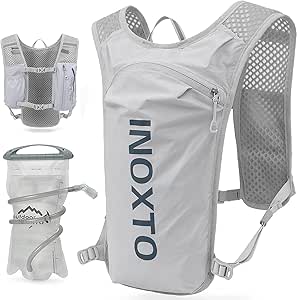
INOXTO Lightweight Running Hydration Vest with 1.5 L Water Bladder
For runners who prefer a hydration bladder over a front-mounted flask, the INOXTO 1.5 L keeps the setup simple: the bladder is included, and the vest weighs 140 g. Its adjustable shoulder straps and hip belt give more ways to secure the load than the SWIFTVEST, which is built around a single 500 ml soft flask. Four pockets and reflective trim add useful storage and visibility without changing the vest’s straightforward focus.
The tradeoff is capacity: 1.5 liters offers less carried water than the N NEVO RHINO’s 2 L bladder, and the product details don’t specify a separate storage volume for gear. I’d choose this for shorter outings where low weight and an included reservoir matter more than hauling extra water or supplies. It is not intended for children 12 and under.
Pros:- 140 g listed weight keeps the vest light.
- Includes a 1.5-liter water bladder.
- Adjustable shoulder straps and hip belt help customize fit.
- Four pockets and reflective trim add storage and visibility.
Cons:- The 1.5-liter bladder holds less than the N NEVO RHINO’s 2-liter reservoir.
- Product details do not state a separate gear-storage capacity.
- Not intended for children 12 and under.
Best for: Adult trail runners on shorter outings who want a lightweight vest with a bladder included and adjustable waist and shoulder fit.
Not ideal for: Runners planning longer or remote routes who need more than 1.5 liters of water or clearly specified space for extra gear.
- Weight:140 g
- Water capacity:1.5 liters
- Material:Polyester
- Pockets:4
- Fit:Adjustable shoulder straps and hip belt
- Included component:Water bladder
- Color:Black
- Warranty:3 years
Our verdict“Choose the INOXTO if you want an included bladder in a lightweight, adjustable vest for shorter trail runs.”
SWIFTVEST Running Phone Holder Vest with 500ml/17oz Water Bottle, Reflective Hydration Vest, Adjustable Light Unisex
The SWIFTVEST is the phone-and-small-essentials pick: its six pockets include a zippered waterproof phone pouch, so a runner can keep a phone protected and reachable without relying on a larger pack. It comes with a 500 ml soft flask, while reflective detailing and adjustable straps suit low-light runs where visibility and a close fit matter. Compared with the INOXTO’s 1.5-liter bladder, this setup is easier to keep compact but carries substantially less water.
That limited capacity makes it a better match for short routes or runs with reliable refill access than for long stretches of trail. The 285 g listed weight is also heavier than the INOXTO’s 140 g, despite the smaller water supply. I’d favor it when pocket organization and a dedicated phone compartment count more than minimizing pack weight or carrying enough water for an extended outing.
Pros:- Six pockets provide dedicated storage for small items.
- Zippered waterproof phone pouch helps protect a phone.
- Includes a 500 ml soft flask.
- Reflective details and adjustable straps support low-light running and fit adjustment.
Cons:- 500 ml capacity may not cover longer trail runs.
- At 285 g, it is heavier than the INOXTO 1.5 L vest despite carrying less water.
- Its neoprene construction may not suit runners seeking a minimal, highly ventilated pack.
Best for: Runners on short, familiar trails who carry a phone and small essentials and value a dedicated waterproof phone pouch.
Not ideal for: Runners on long or remote trails who need more than 500 ml of water or prioritize the lowest possible vest weight.
- Weight:285 g
- Dimensions:11 in W × 14 in H
- Water capacity:500 ml
- Pockets:6
- Material:Neoprene
- Included bottle:500 ml soft flask
- Fit:Adjustable straps
- Model number:SV01
Our verdict“Pick the SWIFTVEST for short runs where phone protection and organized pockets matter more than water capacity and low weight.”
N NEVO RHINO Lightweight Hydration Backpack with 2L Water Bladder
Among these bladder-based options, the N NEVO RHINO carries the most water: its 2-liter BPA-free bladder gives it an advantage over the INOXTO’s 1.5-liter reservoir on longer routes between refill points. The pack weighs 8.5 oz and has a 12-liter capacity, plus an air-mesh back panel and adjustable straps intended to help with airflow and fit. Waterproof, tear-resistant nylon also makes it a more gear-oriented choice than the compact SWIFTVEST, which centers on a single 500 ml flask and phone storage.
That added carrying potential comes with limits. The listing says the storage compartments may not fit larger gear, and the 12-liter capacity may still fall short for long trips that require bulky layers or supplies. I’d choose it for runners who want more water and room than a minimalist vest provides, but I’d compare pack layout against the AONIJIE 5L if a smaller, lighter gear load is the priority.
Pros:- 2-liter BPA-free bladder holds more water than the INOXTO’s 1.5-liter reservoir.
- 12-liter pack capacity provides more stated storage than a small flask vest.
- Air-mesh back panel and adjustable straps support ventilation and fit adjustment.
- Waterproof, tear-resistant nylon is suited to outdoor use.
Cons:- Product details say the small compartments may not fit larger gear.
- The 12-liter capacity may be inadequate for long trips with bulky supplies.
- Its backpack-style storage is less minimal than a compact flask vest such as the SWIFTVEST.
Best for: Trail runners who need a 2-liter bladder and room for essentials on longer outings, but do not need to carry bulky equipment.
Not ideal for: Runners seeking a compact race vest for short runs, or those who need storage for large layers and substantial trail gear.
- Weight:8.5 oz
- Pack capacity:12 liters
- Bladder volume:2 liters
- Material:100% nylon, PU coated
- Back panel:Air mesh
- Dimensions:11.8 in W × 16.5 in H
- Color:Black
- Warranty:365 days
Our verdict“Choose the N NEVO RHINO when a 2-liter bladder and extra pack capacity matter more than a compact running-vest profile.”
MOKURA Running Vest for Women and Men with 500ml Soft Flask & Phone Holder
The MOKURA’s defining feature is how it secures its 500 ml soft flask: elastic compression is designed to limit movement as the water level drops, addressing the bouncing that can make a partly empty bottle distracting on a trail. Its under-10-oz weight, breathable mesh and neoprene, adjustable chest straps, and sweatproof phone holder make it a focused option for runners who want a flask close at hand. Compared with the SWIFTVEST, it has a similar stated water capacity but puts more emphasis on flask stability than on a documented six-pocket layout.
The tradeoff is limited carrying capacity: 500 ml is a small supply for long or remote runs, and the product data gives no pocket count or total gear capacity. The listing also provides fewer construction details than the N NEVO RHINO’s 12-liter pack. I’d favor the MOKURA for shorter routes where a steady flask and phone access matter more than carrying extra water or layers.
Pros:- Under-10-oz weight keeps the vest relatively light.
- Elastic flask compression is designed to reduce bottle bounce as it empties.
- Includes a 500 ml BPA/PVC-free soft flask with a leakproof bite valve.
- Sweatproof phone holder and reflective accents support practical run-day use.
Cons:- 500 ml flask capacity is limited for longer trail routes.
- Product information does not specify pocket count or total storage capacity.
- Provides less water capacity than the INOXTO and N NEVO RHINO bladder options.
Best for: Runners on short to moderate routes who want a 500 ml flask held close, a phone holder, and a lightweight vest.
Not ideal for: Trail runners on remote or extended outings who need a larger water supply or clearly specified room for extra gear.
- Weight:Under 10 oz
- Flask capacity:500 ml
- Vest material:Neoprene and breathable mesh
- Flask material:BPA/PVC-free
- Fit:Adjustable chest straps
- Included component:Soft water bottle
- Phone storage:Sweatproof phone holder with retractable lanyard
- Warranty:2 years
Our verdict“Pick the MOKURA if a stable 500 ml flask and phone access suit your shorter runs better than a larger bladder pack.”
AONIJIE Running Vest Hydration Backpack 5L Unisex Trail Water Lightweight
The AONIJIE 5L is the gear-first choice for runners who want a compact 5-liter vest and easy access to small items rather than a reservoir included in the box. Its nine exterior pockets and adjustable chest and waist straps make it more organized than the INOXTO, while the listed 190 g weight keeps it far below the N NEVO RHINO’s 12-liter backpack in stated storage capacity. A padded, breathable back section is intended to improve airflow between the pack and the runner.
The key catch is that this model ships without a water bladder; a compatible 1.5-liter bladder is optional, so buyers must arrange hydration separately. The listed weight also varies across the supplied product details, which give both 190 g and 5.76 oz. I’d pick it for runners who already own a compatible bladder and want organized, compact storage, not for someone seeking a ready-to-run hydration kit.
Pros:- Five-liter capacity offers a compact alternative to the N NEVO RHINO’s 12-liter pack.
- Nine exterior pockets keep small items accessible.
- Adjustable chest and waist straps help secure the fit.
- Padded, breathable back section is designed to allow airflow.
Cons:- Water bladder is not included, unlike the INOXTO and N NEVO RHINO packs.
- A compatible bladder must be sourced separately for reservoir hydration.
- Supplied product details list conflicting weights: 190 g and 5.76 oz.
Best for: Trail runners who already own a compatible 1.5-liter bladder and want a compact vest with numerous accessible pockets.
Not ideal for: Buyers who need a complete hydration setup in the package or want more than 5 liters of pack capacity for bulky gear.
- Pack capacity:5 liters
- Weight:190 g (also listed as 5.76 oz)
- Pockets:9 exterior pockets
- Compatible bladder volume:1.5 liters, optional and not included
- Dimensions:11.02 in W × 16.93 in H
- Chest circumference:25.59–53.15 in
- Fit:Adjustable shoulder, chest, and waist straps
- Color:Black
Our verdict“Choose the AONIJIE 5L if you want compact, pocket-rich storage and already have a compatible bladder.”

How We Picked
I compared the 15 listed vests by the factors that affect trail running decisions: water-carrying format and capacity, storage volume, adjustment features, stated fit, and whether the design is presented specifically for running or for several activities. I also weighed how clearly each option matches a use case, from short runs with a single flask to longer outings that call for a bladder and room for extra gear. A named water capacity or storage figure helps clarify a pack’s role, but it does not tell the whole story; fit and access matter just as much on a moving trail.
The ranking gives priority to running-specific design and useful versatility, then separates the picks by their strongest practical role. The Nathan Vapor Air 3.0 ranks first as a purpose-built bladder option; the Osprey Duro LT earns recognition for a more pared-back running setup, while the AONIJIE 12L is a better match when carrying space matters most. Models with more limited capacity or broader activity claims sit lower when their listing offers less evidence of a trail-running advantage. I do not treat listed features as proof of bounce control, durability, or comfort, so buyers should check sizing guidance and pack specifications before choosing.
Factors to Consider When Choosing Trail Running Hydration Vests
Product names and capacity figures narrow the field, but choosing a vest is also about how your route, body, and gear interact. I would decide on water access and fit before comparing pocket counts: a roomy pack that shifts while running can be less useful than a smaller one that stays settled. These factors help avoid buying more capacity or features than your typical outing calls for.
Match Water Carry to Your Route
Start with the longest stretch you expect to run without a reliable refill, not with the biggest capacity listed. A 500ml flask setup may make sense for shorter routes or runs with refill access, while a 1.5L or 2L bladder can carry more water between stops. More water also means more carried weight, so filling every container for a short outing can make a vest feel needlessly loaded. Think about whether you prefer to sip from a tube or remove a bottle while moving. If you run routes with frequent water access, flexibility and easy refilling may matter more than maximum volume. Choose a system you can clean and dry properly after use, since a neglected reservoir can become unpleasant to use.
Choose Between Front Flasks and a Bladder
Soft flasks sit within reach on the front of many vests, making it easier to monitor how much water remains and refill without unloading the pack. A bladder typically carries water against the back and can offer a larger single reservoir, but checking its remaining level is less immediate. The choice also affects how you manage water: separate flasks let you divide a drink or carry different fluids, while one bladder keeps the setup straightforward. Do not assume a vest supports both formats unless its specifications say so. Consider your preferred drinking rhythm and whether you want to reach water without slowing down. The easier system to access on your usual terrain is often the one you will use consistently.
Prioritize Fit and Stability Over Pocket Count
A vest should sit close enough to limit movement without restricting breathing or arm swing. Adjustable chest straps can help accommodate layers and differences in torso shape, but strap placement and the available size range still matter. A product described as unisex may not fit every body in the same way, so check its sizing chart and return terms before committing. Try any vest with the water and gear you expect to carry; an empty pack can sit differently from a loaded one. Pocket access matters too, especially if you carry snacks or a phone and want to reach them without removing the vest. More pockets are useful only when their locations work for your stride and preferred gear.
Pick Storage for Your Actual Trail Kit
Estimate the space needed for the items you routinely carry, such as a phone, food, keys, a light layer, and basic safety gear. A 12L vest gives more room for supplies than a compact 3L design, but the extra space can invite overpacking on a short run. Conversely, a low-capacity vest may leave little room for a layer when the weather changes. Check whether storage space is listed separately from water capacity; those numbers describe different things. Think through where each item will go, since a pocket that fits a phone but is hard to reach may not solve your needs. Choose enough room for your regular kit with a little margin, rather than buying based on an unusually demanding outing.
Decide Whether You Need a Trail-Specific Vest
Some options in this roundup are presented for running alone, while others also target hiking, cycling, or marathon use. A broader-use pack may be appealing if you want one hydration carrier for several activities, but those claims do not establish how stable it feels at a running pace. Trail terrain can make secure adjustment and easy access more noticeable than they are during a walk. For regular trail runs, favor clear information about running fit, carried water, and storage placement over a long list of activity labels. For occasional runs mixed with hiking or cycling, a versatile pack can be a practical compromise. In either case, check the complete specifications rather than relying on the product name alone.
Account for Cleaning and Upkeep
Hydration gear needs regular cleaning, and the container style affects the routine. A bladder and drinking tube can take more effort to rinse and dry than a removable flask, particularly if you use anything other than water. Before buying, check whether the reservoir or flasks detach easily and whether the openings are wide enough for your preferred cleaning tools. Letting a water system stay damp between runs can lead to stale smells and residue. Also check whether replacement containers are available if a flask or tube wears out. A slightly simpler setup may be the better long-term choice if you want low-effort care.
Frequently Asked Questions
Should I choose a 500ml soft flask or a 1.5L to 2L bladder for trail running?
Choose based on the distance between dependable refill points and how much water you normally carry, rather than the vest’s maximum capacity alone. A 500ml flask can suit short runs or routes with accessible water, and front placement makes the remaining amount easy to check. A 1.5L or 2L bladder carries more between stops, which can be useful on longer routes, but adds weight and takes more cleaning. Some runners also prefer a bladder tube while others find front flasks easier to reach. If you are unsure, estimate your water needs for a typical route and check whether the vest can carry a second container.
Will a hydration vest fit comfortably over different layers?
Fit depends on the vest’s size range, strap adjustment, and your torso shape, so a unisex label by itself cannot predict comfort. Check the manufacturer’s sizing chart and measure as directed, then account for whether you will wear a base layer or a light jacket underneath. Chest straps that adjust can help with fit changes, but they do not replace a suitable size. A vest should feel secure without limiting a full breath or arm movement. If possible, confirm the return policy before buying, since fit can be difficult to judge from product details alone.
Is a larger-capacity vest a better choice for every trail run?
No. More capacity can give you space for water, food, and an extra layer, but it may add bulk and make it easier to carry items you do not need. The AONIJIE 12L in this lineup targets runners who need substantial room, whereas a compact option is more sensible for a short outing with a light kit. Match storage to your typical route and carry the essentials you actually use. If your needs vary widely, a mid-capacity pack may be a more practical compromise than choosing the largest option. Water volume and gear storage are separate needs, so compare both figures.
Can a hiking or cycling hydration pack work for trail running?
It can, but activity labels alone do not tell you whether a pack will stay comfortable at a running pace. A design made for several activities may provide useful versatility, while a running-focused vest may place water and pockets where runners can reach them more readily. Look for adjustment details, fit information, and how the pack carries its water before deciding. When possible, try it with a full reservoir and your normal gear, since movement can change how stable it feels. If trail running is your main use, favor evidence of a secure running fit over a broad list of intended activities.
How much should I prioritize easy cleaning when choosing a hydration vest?
Cleaning matters because water containers and tubes stay in contact with moisture between runs. If you want a low-effort routine, check how easily the flask or bladder detaches, how its opening can be cleaned, and whether the tube can be dried. Soft flasks may be simpler to remove and rinse, while bladder systems can require extra attention to the reservoir and hose. Your routine also depends on what you drink: anything beyond water may leave more residue. Choose a system you are willing to clean after the kinds of runs you plan to do, rather than treating maintenance as an afterthought.
Conclusion
For most trail runners seeking one capable, running-focused setup, I recommend the Nathan Vapor Air 3.0 as best overall, with its 2L bladder and purpose-built positioning. The AONIJIE 12L is my best value-style choice for gear capacity among these picks, particularly for runners who need room for extra supplies, while the Osprey Duro LT is a strong option for buyers who prefer a more pared-back running vest. For beginners, I would start with a flask-based option such as the Zelvot vest with a 500ml soft flask if a simple, smaller water load matches their routes; check fit and capacity before deciding. The Nathan Vapor Air 3.0 is also the premium-leaning pick for a runner prioritizing a dedicated bladder setup, while the AONIJIE 12L is better for those carrying layers or more gear. Choose a compact flask vest for shorter runs, a larger bladder model for longer stretches between refills, and a broader-use INOXTO pack if you want one carrier for running alongside hiking or cycling.
NFL season / tailgating Picks
team gear
As an affiliate, we earn on qualifying purchases.