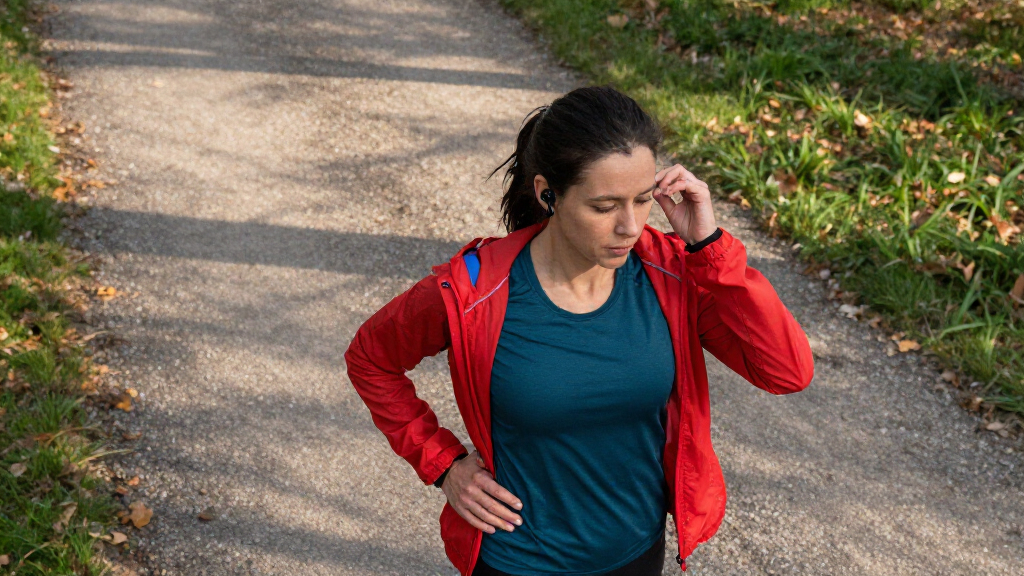

Choosing wireless sports earbuds is less about finding a single winner than deciding how much you value hearing your surroundings against keeping outside noise out. Open-ear models sit outside the ear canal, often using hooks or clips, while in-ear models seal inside it with fitted tips or a stabilizing design. That difference affects safety, comfort, sound and how well each style stays put during a workout.

Get sports gear delivered free with Prime
- Fast, free delivery on millions of items
- Prime Video, Amazon Music and more included
- Member-only deals all year

SHOKZ OpenRun Pro 2 Bone Conduction Bluetooth Sport Headphones, Black
- ✔ Audio technology: Bone and air conduction
- ✔ Fit: Open-ear
- ✔ Battery life: Up to 12 hours

GNMN V7 Wireless Earbuds with Active Noise Cancellation, Ear Hooks, and IPX7 Waterproofing
- ✔ Noise control: Active noise cancellation and transparency mode
- ✔ Fit: Ear hooks with customizable tips
- ✔ Playback time: Up to 8 hours per charge; up to 96 hours with case

HILDCROA BX31 Wireless Sports Earbuds
- ✔ Bluetooth: 5.3
- ✔ Fit: Ear hooks with three ear-tip sizes
- ✔ Playback time: Over 8 hours per charge; up to 75 hours with case
Open-ear earbuds suit outdoor runners, cyclists and people who dislike plugged ears. In-ear sports earbuds are the stronger choice for gym sessions, noisy routes and listeners who want fuller bass or a more immersive sound. Fit and features vary by model, so compare those directly before buying; the category-level tradeoff is clear, but it does not guarantee that every pair will feel or perform the same.
At a Glance
| Criteria | Open-ear wireless sports earbuds | In-ear wireless sports earbuds | Winner |
|---|---|---|---|
| Awareness of surroundings | Usually lets in more ambient sound | A seal can reduce awareness unless a transparency feature is provided | A |
| Noise isolation | Limited passive isolation | Generally stronger passive isolation | B |
| Sound and bass | Typically less bass impact; sound leaks more readily | Usually fuller bass and a more immersive sound | B |
| Fit during movement | Hooks or clips can hold the buds in place without a canal seal | A well-fitted pair can feel stable; the right tips matter | Depends |
| Long-session comfort | No ear-canal seal, but hooks or contact points may create pressure | A tight seal or tip pressure may tire some listeners | Depends |
| Sweat and weather suitability | Depends on model rating and construction | Depends on model rating and construction | Depends |
| Value | Worth paying for when environmental awareness is a priority | Often the stronger all-round value for sound and gym use | Depends |
SHOKZ OpenRun Pro 2 Bone Conduction Bluetooth Sport Headphones, Black
The SHOKZ OpenRun Pro 2 is the clearest choice for workouts where hearing the environment is part of the experience. Its open-ear fit and combination of bone and air conduction leave the ear canals uncovered, which makes it a better match for outdoor runners who want awareness of nearby sounds than either hooked in-ear model. The memory wire and ergonomic ear hooks are designed to hold the lightweight frame in place without relying on tips inside the ears.That open design defines the tradeoff. SHOKZ lists up to 12 hours of battery life, longer per charge than the up-to-eight-hour figures supplied for GNMN and HILDCROA, but it provides limited sound isolation. In noisy surroundings, the GNMN V7’s active noise cancellation is better suited to reducing distractions, and HILDCROA’s in-ear format also creates a more enclosed fit. SHOKZ is rated IP55, below the IPX7 ratings listed for those two alternatives, so buyers prioritizing the strongest stated water protection may prefer one of them.App EQ modes and dual wind-resistant microphones with AI noise reduction add flexibility for music and calls. Those features make this the most distinctive all-around sports pick in this group, especially for people who do not want ear tips. Choose it for awareness and an open fit; skip it if you need isolation in loud environments or want an IPX7 rating.
Pros:
- Open-ear design helps preserve awareness of nearby sounds.
- Bone and air conduction drivers are designed to deliver clear highs and deep bass.
- Lightweight frame with memory wire and ergonomic ear hooks.
- Up to 12 hours of listed battery life per charge.
Cons:
- Open-ear fit provides limited sound isolation, especially in noisy settings.
- IP55 rating is lower than the IPX7 ratings listed for GNMN and HILDCROA.
Best for: Outdoor runners and cyclists who want a secure open-ear fit and awareness of surrounding sounds.
Not ideal for: Listeners who need strong sound isolation, regularly exercise in very noisy places, or prioritize an IPX7 rating.
Bottom line: For outdoor sports where awareness matters more than isolation, SHOKZ is the most distinctive and balanced pick in this comparison.
“For outdoor sports where awareness matters more than isolation, SHOKZ is the most distinctive and balanced pick in this comparison.”
GNMN V7 Wireless Earbuds with Active Noise Cancellation, Ear Hooks, and IPX7 Waterproofing
If workouts happen around gym noise or other distractions, the GNMN V7 offers the most control over what reaches your ears. It pairs active noise cancellation with a transparency mode, so it can suit both focused indoor sessions and moments when hearing more of the surroundings is useful. That flexibility separates it from HILDCROA, whose supplied feature list describes ENC microphone noise reduction but does not specify listening-side active noise cancellation.The V7 uses soft ear hooks and customizable tips for a more anchored, enclosed fit than SHOKZ’s open-ear frame. That can make it appealing for exercise where a tip-based fit feels secure, but the hooks take up more space and may bother people who prefer compact, hook-free earbuds. The IPX7 water resistance is a stronger stated rating than SHOKZ’s IP55. Per-charge playback is listed at up to eight hours, shorter than SHOKZ’s up-to-12-hour figure, while the claimed total rises to up to 96 hours with the charging case. The case total is useful context for repeated sessions, though it does not mean the earbuds run for that long between charges.A 16 mm driver, USB-C charging, and a battery display round out the listed package. Compared with HILDCROA, GNMN gives buyers explicit listening modes and a higher case-supported runtime; compared with SHOKZ, it trades open-ear awareness and longer per-charge playback for a more enclosed, adjustable listening experience. Pick it for noise control and case capacity; skip it if you want an unobstructed ear or dislike ear hooks.
Pros:
- Active noise cancellation and transparency mode provide different listening options.
- IPX7 water resistance is suited to buyers prioritizing a higher listed water-protection rating.
- Ear hooks and customizable tips are designed to hold the earbuds securely during exercise.
- Charging case lists up to 96 hours of total playback and has a battery display.
Cons:
- Per-charge playback is listed at up to 8 hours, below SHOKZ’s up-to-12-hour figure.
- Ear hooks may feel bulky to listeners who prefer a compact, hook-free design.
- The up-to-96-hour figure includes playback from the charging case.
Best for: Gym users who want active noise cancellation, a transparency option, and a hooked in-ear fit.
Not ideal for: People who prefer open-ear awareness, compact hook-free earbuds, or longer listed playback on a single charge.
Bottom line: GNMN is the most versatile pick for workouts where buyers want in-ear noise control and a long case-supported runtime.
“GNMN is the most versatile pick for workouts where buyers want in-ear noise control and a long case-supported runtime.”
HILDCROA BX31 Wireless Sports Earbuds
The HILDCROA BX31 is a straightforward hooked-earbud option for buyers who want a workout-focused fit and water protection without needing a full set of listening modes. Lightweight TPE ear hooks and three ear-tip sizes offer ways to tailor the fit, while the listed IPX7 rating matches GNMN’s stated water protection and exceeds SHOKZ’s IP55 rating on paper. For sweat-prone sessions, those details may matter more than an open-ear design or noise cancellation.Its listed playback is over eight hours per charge, with up to 75 hours total when counting the charging case. That case-supported figure is lower than GNMN’s up-to-96-hour claim, though both offer more total listening than their per-charge numbers suggest. HILDCROA lists a 13 mm driver, Bluetooth 5.3, USB-C charging, touch controls, and an LED battery display. Those are useful everyday features, but the description does not specify active noise cancellation. ENC refers to microphone noise reduction, which should not be confused with a mode that reduces noise for the listener.Compared with GNMN, the BX31 is the more basic choice: it still has ear hooks, an in-ear fit, and IPX7 protection, but its feature list leaves out ANC and transparency mode. Compared with SHOKZ, it gives up open-ear awareness in favor of ear tips and a more enclosed fit. Its listed 90-day warranty is also shorter than GNMN’s stated five-year warranty, a difference buyers may want to weigh alongside their priorities. Choose HILDCROA when a hooked fit and simple workout essentials are enough; look elsewhere if you want explicit noise-control options.
Pros:
- Ear hooks and three tip sizes provide fit options for exercise.
- IPX7 water resistance is listed for wet workout conditions.
- Charging case lists up to 75 hours of total playback and includes an LED battery display.
- USB-C charging, touch controls, and Bluetooth 5.3 are specified.
Cons:
- Active noise cancellation is not specified; ENC is listed for microphone noise reduction.
- The up-to-75-hour total includes the case and is lower than GNMN’s stated up-to-96-hour total.
- The listed 90-day warranty is shorter than GNMN’s stated five-year warranty.
Best for: Workout listeners who want hooked earbuds, multiple tip sizes, and IPX7 protection without requiring ANC.
Not ideal for: Buyers who want listening-side active noise cancellation, a longer per-charge figure, or an open-ear fit.
Bottom line: HILDCROA suits buyers who want a simple, water-resistant hooked fit, but GNMN is the stronger choice if noise-control modes matter.
“HILDCROA suits buyers who want a simple, water-resistant hooked fit, but GNMN is the stronger choice if noise-control modes matter.”
As an Amazon Associate we earn from qualifying purchases.
Key Differences
The most meaningful difference is how each style handles the outside world. Open-ear earbuds preserve more ambient sound, which can help a runner notice traffic or a cyclist hear nearby activity. That awareness is useful, but it is not a substitute for attention or safe riding practices. In-ear earbuds do the opposite: their seal reduces distractions and helps music stand out, especially in a gym or on a busy commute.
Sound quality and comfort are less absolute. In-ear designs usually have an advantage in bass and isolation, while open-ear designs avoid the plugged sensation some listeners dislike. Yet an ear hook can rub, and an in-ear tip can feel comfortable if it fits well. For either style, the specific model, fit, volume and features matter. Pay extra for the design that solves a real problem in your routine, not for a broad claim that one category is universally superior.
Detailed Comparison
Awareness of surroundings (Open-ear wireless sports earbuds wins — major)
Open-ear wins by a major margin for workouts where environmental sound matters. Since the ear canal remains open, runners and walkers are more likely to hear nearby traffic, people or announcements. In-ear earbuds can block some of that sound; a transparency mode may help, but its performance depends on the model and setting. Choose open-ear for awareness, while still keeping volume sensible and staying alert.
Noise isolation (In-ear wireless sports earbuds wins — major)
In-ear wins by a major margin when the goal is to reduce external noise. The ear tip creates a seal that can make music easier to hear in a busy gym or on a noisy indoor trainer. Open-ear models let more sound through, so you may raise the volume to compete with background noise. For noisy settings, a good in-ear fit is more practical; avoid turning music up to unsafe levels.
Sound and bass (In-ear wireless sports earbuds wins — moderate)
In-ear usually wins by a moderate margin for bass and an enveloping sound. The seal helps deliver low frequencies and keeps playback more consistent. Open-ear earbuds can be enjoyable for podcasts and workout playlists, but their sound is more exposed to surroundings and may feel lighter at the low end. Listeners who want strong bass should favor in-ear; those who put awareness first may accept the tradeoff.
Fit during movement (moderate difference)
There is no category-wide winner. Open-ear hooks or clips can keep a bud positioned without relying on a canal seal, which some people find reassuring during runs. In-ear models can also stay secure when the tip and stabilizer match the ear. A poor fit in either style can shift, rub or fall out. The practical winner is the pair that stays comfortable during the movements you actually do, so use a return window or fit trial if available.
Long-session comfort (moderate difference)
This depends on ear shape and personal tolerance. Open-ear earbuds avoid tip pressure inside the canal, an advantage for people who dislike sealed ears or wear buds for long sessions. Hooks may press on the outer ear, though, and can become irritating. In-ear tips may feel unobtrusive when correctly sized, but a tight seal can cause fatigue. Neither style is automatically more comfortable; fit, weight and contact points decide the result.
Sweat and weather suitability (minor difference)
Tie at the category level. Both styles include workout models, but water resistance depends on the particular product and its rating, not whether it is open-ear or in-ear. Sweat, rain and cleaning needs vary by use. Check the stated protection rating and care instructions, especially if training outdoors or sweating heavily. Do not assume an athletic appearance means a pair is suitable for wet conditions.
Value (moderate difference)
It depends on the buyer’s main use. In-ear sports earbuds often cover more situations with isolation and fuller sound, making them a solid default for gym users. Open-ear models earn their cost for people who regularly exercise outdoors and value ambient awareness or cannot tolerate canal tips. Paying more for either category makes sense only when the specific fit, durability, controls or listening features justify it for your routine.
Open-ear wireless sports earbuds: Pros and Cons
Pros:
- Leaves the ear canal open, preserving more awareness of nearby sound.
- Avoids the sealed-ear feeling that bothers some listeners.
- Can work well for outdoor running and walking where awareness is useful.
Cons:
- Usually provides less bass and less immersive sound.
- Offers limited noise isolation, which can be a drawback in a noisy gym.
- Hooks or clips can rub or press on the outer ear.
In-ear wireless sports earbuds: Pros and Cons
Pros:
- Typically provides stronger passive isolation and fuller bass.
- Can make music clearer in a busy gym or other noisy indoor setting.
- Many tip sizes and stabilizing designs are available across models.
Cons:
- The seal can reduce awareness of surroundings.
- Tip pressure or a tight fit may become uncomfortable over long sessions.
- A secure and comfortable fit depends on choosing suitable tips and design.
Who Should Choose What
Choose Open-ear wireless sports earbuds if:
- You run or walk outdoors and want to hear more of the activity around you.
- You dislike the sensation of an ear tip sealing your canal.
- You mainly listen to spoken audio or accept lighter bass in exchange for awareness.
Choose In-ear wireless sports earbuds if:
- You train mostly in a gym or other noisy indoor space.
- You want stronger bass, a more immersive sound or passive noise reduction.
- You have found an in-ear fit that remains secure and comfortable during exercise.
Skip both if: Neither style fits comfortably after trying different sizes or shapes, or you need hearing protection in a loud environment. Use properly rated protective equipment for hazardous noise rather than relying on music earbuds.
Value for Money
For a gym-first listener, in-ear sports earbuds are usually the better value: isolation and fuller bass serve everyday listening as well as training. Paying more can be worthwhile if the model adds a reliably comfortable fit, useful controls, strong sweat protection or a transparency mode you will use. Extra features only matter when they improve your routine.
Open-ear earbuds justify a higher price for people who regularly exercise outdoors and place a premium on hearing ambient sound, or who cannot tolerate canal tips. If you mostly train indoors and want rich sound, the open-ear premium may buy a feature you rarely need. Compare specific models on fit, protection rating and battery life; price alone does not tell you which one is the better purchase.
Final Verdict
Choose in-ear wireless sports earbuds if you want one pair for gym workouts, fuller bass and less background noise; they are the stronger default for most indoor training. Choose open-ear earbuds if outdoor awareness or avoiding a sealed canal is central to your comfort. The biggest deciding factor is whether you need to hear your environment or block it out. If you cannot find a secure, comfortable fit in either style, skip both and try a different design before committing.
Frequently Asked Questions
Are open-ear earbuds safer for running outside?
They let more ambient sound reach your ears, which can help you notice traffic or nearby people. They do not replace attention: keep volume at a sensible level, stay alert and follow local rules for running or cycling.
Do in-ear sports earbuds stay in during a run?
They can, if the tips and stabilizers fit your ears well. Try the supplied sizes and test the fit with movement. If the earbuds shift, loosen or cause discomfort, that model may not suit your ears.
Are open-ear earbuds good for the gym?
They can work well if you want to hear announcements or people nearby. In a loud gym, their limited isolation may make music harder to hear, so in-ear earbuds are often the more practical choice.
Is it worth paying more for sports earbuds?
Pay more when a specific feature solves a regular problem, such as a more stable fit, useful water resistance or effective transparency mode. For many gym users, a well-fitting mid-priced in-ear pair offers better value than paying extra for a style they do not need.