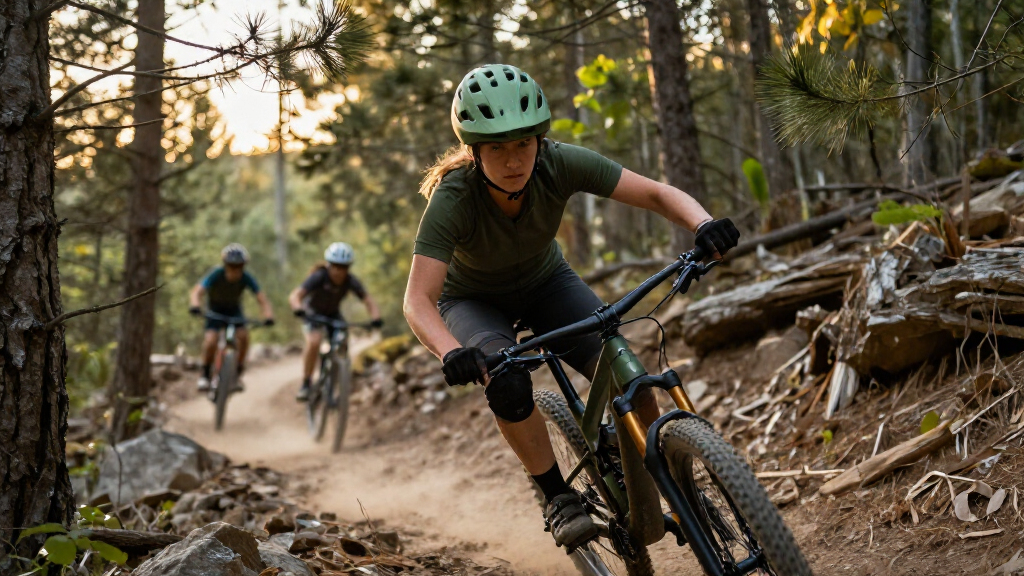

Choosing between an open-face and full-face mountain bike helmet is mainly a decision about how much coverage your riding calls for and how much weight and heat you are willing to carry. Open-face helmets cover the top and back of the head, with extended coverage on many trail models; full-face helmets add a chin bar and surround the jaw. That extra coverage can matter on steep, technical descents, jumps, and bike-park laps, but it usually makes a helmet heavier and warmer. For most cross-country and everyday trail riders, an open-face helmet is the more practical choice. Riders tackling demanding downhill terrain or seeking more facial coverage should look closely at a well-fitted full-face model.

Get sports gear delivered free with Prime
- Fast, free delivery on millions of items
- Prime Video, Amazon Music and more included
- Member-only deals all year

BATFOX Mountain Bike Helmet with Visor
- ✔ Model: LA303
- ✔ Shell and liner: Polycarbonate shell; EPS liner
- ✔ Safety standards: CPSC, ASTM F1447, CE

ANYPASS Adult Mountain Bike Helmet with Removable Sun Visor
- ✔ Model: 015
- ✔ Shell and core: Polycarbonate shell; high-density EPS foam
- ✔ Construction: In-mold
BATFOX Mountain Bike Helmet with Visor, Adjustable Fit, Sizes M–XL
- ✔ Model: LA303
- ✔ Shell and liner: Polycarbonate shell; EPS liner
- ✔ Safety standards: CPSC, ASTM F1447, CE
At a Glance
| Criteria | Open-face mountain bike helmets | Full-face mountain bike helmets | Winner |
|---|---|---|---|
| Coverage and facial protection | Covers the head; no chin bar, so the face and jaw remain exposed | Adds a chin bar and jaw coverage; exact protection depends on design and certification | B |
| Weight and freedom of movement | Usually lighter and less restrictive | Heavier and more enclosing | A |
| Ventilation and heat | Generally more airflow, especially at low speeds | Typically warmer, though vent design varies | A |
| Best riding conditions | Cross-country, general trail riding, and climbs | Downhill, bike parks, jumps, and demanding descents | Depends |
| Convenience and communication | Easy to carry, remove, and talk in | More cumbersome off the bike; speech may be less clear | A |
| Price and value | Often less expensive; strong everyday value | Often costs more; added coverage pays off for riders who need it | Depends |
BATFOX Mountain Bike Helmet with Visor
The BATFOX LA303 is our most balanced pick because its three size bands cover 54–63 cm, while the dial fit system lets riders fine-tune the hold once they choose the right size. That range gives it an advantage over the ANYPASS, which lists only M and L and tops out at 61 cm. BATFOX also specifies 18 vents with internal channels, a useful design detail for riders who expect sustained climbing or warm-weather trail time.Its description names CPSC, ASTM F1447 and CE standards, and pairs a polycarbonate shell with an EPS liner. Those details make the specification sheet comparatively complete, but they do not tell us how the helmet fits an individual head or how it performs beyond the stated standards. The large visor and washable padding add everyday practicality; the visor may be cumbersome for riders who prefer a minimal profile or whose riding setup calls for another arrangement.We place this listing ahead of the other BATFOX because it gives a weight of 13.76 ounces and is the first of two descriptions of the LA303. The second lists 380 g, with no clear evidence of a different construction. Since the supplied weights use different units and are not identical, we would not treat either listing as definitively lighter without checking the specific unit. Choose this BATFOX for its broad size options and stated standards, rather than expecting a clear design difference from its near-twin.
Pros:
- Three listed size ranges span 54–63 cm.
- Eighteen vents use internal channeling.
- States CPSC, ASTM F1447 and CE standards.
- Removable washable padding and adjustable dial.
Cons:
- The listed range does not cover heads above 63 cm.
- Large visor may not suit every riding setup.
- Weight is listed in ounces, limiting direct comparison with the other BATFOX entry.
Best for: Trail riders whose measured head circumference falls between 54 and 63 cm and who want a dial-adjusted fit and a large visor.
Not ideal for: Riders who need a size beyond 63 cm, want a visor-free helmet or need a confirmed fit shape before purchase.
Bottom line: We rank this BATFOX first for its broad size choices, dial adjustment and clearly stated standards, while recommending a careful fit check and visor preference check.
“We rank this BATFOX first for its broad size choices, dial adjustment and clearly stated standards, while recommending a careful fit check and visor preference check.”
ANYPASS Adult Mountain Bike Helmet with Removable Sun Visor
ANYPASS makes the strongest case for riders who prioritize a lighter listed helmet and more coverage around the back and sides. At 330 g, it is the lowest stated weight among these entries. Its description specifically notes deeper rear and side coverage for trail riding, which gives it a distinct role beside the BATFOX options, whose descriptions emphasize vents, visor and size flexibility instead.It still covers the practical basics: in-mold polycarbonate and high-density EPS construction, 17 vents, a rear adjustment dial and removable washable padding. Compared with the BATFOX LA303, it has one fewer listed vent and its size options stop at 61 cm, whereas BATFOX extends to 63 cm. The detachable visor is convenient for riders who want the option to change the profile, although riders who already know they dislike visors may find it an unnecessary component.The two sizes, M at 54–58 cm and L at 57–61 cm, overlap between 57 and 58 cm. We should follow the maker’s fit guidance and try the helmet on where possible rather than selecting by a dial alone. The listing states U.S. CPSC compliance and a two-year warranty, but does not give the broader standards list found in the BATFOX description. This is the better fit for a rider who values its lower stated weight and coverage notes over the BATFOX’s additional size band.
Pros:
- Listed weight is 330 g.
- Description calls out deeper rear and side coverage for trail riding.
- Removable washable padding and detachable visor.
- Rear adjustment dial and stated two-year warranty.
Cons:
- Only M and L sizes are listed, ending at 61 cm.
- Seventeen vents, one fewer than the BATFOX listings.
- Description names CPSC but not the additional standards stated by BATFOX.
Best for: Riders within the listed M or L range who value a lower stated weight, washable pads and deeper back and side coverage.
Not ideal for: Riders with head measurements above 61 cm, those needing the BATFOX’s stated three-standard coverage, or anyone seeking a visor-free design.
Bottom line: We recommend ANYPASS when its 330 g listed weight and deeper coverage notes matter more than BATFOX’s third size band and broader stated standards.
“We recommend ANYPASS when its 330 g listed weight and deeper coverage notes matter more than BATFOX’s third size band and broader stated standards.”
BATFOX Mountain Bike Helmet with Visor, Adjustable Fit, Sizes M–XL
This second BATFOX entry appears to describe the same LA303 platform as our top pick: the same three sizes, 18-vent layout, dial adjustment, washable lining, large visor and stated CPSC, ASTM F1447 and CE standards. That makes it a useful alternate listing to compare, but the product details supplied here do not establish a meaningful design upgrade or a different trail use case. We rank it third because the first BATFOX entry already covers the same strengths with a similarly complete feature description.The distinguishing specification is its listed 380 g weight. That gives buyers a clear figure for this listing, but the other BATFOX weight is provided as 13.76 ounces, so the two descriptions are not directly aligned in their stated units. We should check the specific product page and variant before drawing a conclusion about which LA303 listing is lighter. Against ANYPASS, this model gives one extra size band up to 63 cm and three named standards, while ANYPASS lists 330 g and mentions deeper rear and side coverage.As with the other BATFOX, 18 vents with internal channels and a dial-adjusted fit are useful stated features, but comfort depends on head shape and correct sizing. Its large visor may be welcome for riders seeking a prominent shield; riders who want a compact or visor-free setup should look elsewhere. We would choose this entry when this exact listing’s stated weight and size chart match our needs, rather than assuming it offers a distinct helmet design.
Pros:
- Lists 380 g weight.
- Three dial-adjusted size ranges cover 54–63 cm.
- Eighteen vents with internal channeling.
- Removable washable lining and chin pad.
Cons:
- Appears to duplicate the other BATFOX LA303 listing’s design and features.
- Weight cannot be compared cleanly with the other BATFOX listing’s ounce figure.
- Large visor and 63 cm size ceiling may not suit all riders.
Best for: Buyers comparing BATFOX LA303 listings who want a stated 380 g weight and sizes from 54 to 63 cm.
Not ideal for: Riders seeking a demonstrably different BATFOX design, a visor-free helmet or a size outside the stated 54–63 cm range.
Bottom line: We treat this as an alternate LA303 listing rather than a separate design choice, and would compare its exact weight and size details with the first BATFOX before deciding.
“We treat this as an alternate LA303 listing rather than a separate design choice, and would compare its exact weight and size details with the first BATFOX before deciding.”
As an Amazon Associate we earn from qualifying purchases.
Key Differences
The largest difference is coverage. An open-face helmet leaves the lower face exposed, while a full-face helmet adds a chin bar around the jaw. That design can provide more coverage in a crash involving the face, but neither type eliminates injury risk. Protection also varies by helmet construction, fit, certification, and whether a model is designed for the riding you do. Check the product’s stated certifications and intended use rather than assuming all helmets of one style offer the same protection.
Comfort and riding pace create the other main tradeoff. Open-face helmets tend to weigh less, allow more airflow, and make it easier to hear and speak. Those advantages matter when a ride includes long climbs, warm weather, frequent stops, or hours on mixed terrain. Full-face helmets are more enclosing and often warmer, but the added coverage can be worth carrying on steep, fast, or jump-heavy routes. A lightweight or convertible design may narrow the comfort gap, although it cannot make every model equally suitable for every ride.
For value, the deciding question is whether the added coverage matches your actual riding. A more expensive full-face helmet can be a sensible purchase for regular downhill or bike-park use; for mellow trails, its extra weight and heat may bring little practical benefit. In either category, a comfortable, correctly sized helmet with suitable certification is a better choice than a higher-priced model that fits poorly.
Detailed Comparison
Coverage and facial protection (Full-face mountain bike helmets wins — major)
Full-face helmets win by a meaningful margin in coverage: the chin bar surrounds the jaw and covers more of the lower face, while open-face helmets leave those areas exposed. That may matter most on descents, jumps, and other riding where a fall could involve the face. It does not make a full-face helmet injury-proof, and the exact protection depends on the model’s design and certification.
Weight and freedom of movement (Open-face mountain bike helmets wins — moderate)
Open-face helmets usually win. With less material around the head, they generally feel lighter and less enclosing over a long ride. That difference can be noticeable on climbs or when moving between sections of trail. Full-face helmets trade some ease of movement for added coverage; a lighter model can reduce, but not erase, that tradeoff.
Ventilation and heat (Open-face mountain bike helmets wins — moderate)
Open-face helmets generally allow more airflow, a clear advantage during slow climbs and warm-weather rides. Full-face helmets can feel warmer because the chin bar and greater coverage enclose more of the head and face. Vent layouts vary, so comparing specific models helps, but ventilation is still a substantial practical advantage for open-face designs on long, low-speed routes.
Best riding conditions (major difference)
The winner depends on terrain and pace. Open-face helmets suit cross-country rides, ordinary trail networks, and routes with extended climbing. Full-face helmets make more sense for sustained downhill riding, bike parks, jumps, and demanding descents where extra facial coverage is a priority. Match the helmet to the hardest riding you regularly do, not just the easiest part of a typical route.
Convenience and communication (Open-face mountain bike helmets wins — minor)
Open-face helmets are easier to take off between runs and usually make conversation and hearing trail sounds less cumbersome. A full-face helmet can feel awkward at stops and may make speech harder to understand. Riders who use a full-face model only for downhill laps can accept that inconvenience; for an all-day mixed-terrain ride, open-face convenience tends to matter more.
Price and value (moderate difference)
Open-face models often cost less, giving general trail riders strong value without paying for coverage they may rarely use. Full-face models can cost more, but the extra expense has a clear purpose for regular downhill and bike-park riders. Prices vary across both categories, so compare fit, construction, certification, and intended use rather than treating price alone as a measure of protection.
Open-face mountain bike helmets: Pros and Cons
Pros:
- Usually lighter and easier to wear for long rides
- Typically better ventilated for climbs and warm weather
- Convenient for mixed terrain, stops, and conversation
- Often a lower-cost choice for everyday trail use
Cons:
- Leaves the jaw and lower face exposed
- May not suit riders who prioritize more coverage on steep descents or at bike parks
- Coverage varies: a standard open-face design may protect less of the back of the head than an extended-coverage trail model
Full-face mountain bike helmets: Pros and Cons
Pros:
- Chin bar adds coverage around the jaw and lower face
- A sensible match for many downhill, bike-park, and jump-focused rides
- Some riders may prefer its more enclosing design for demanding terrain
Cons:
- Usually heavier and warmer than an open-face helmet
- Can feel cumbersome on long climbs and mixed-terrain rides
- Often costs more, with limited value for riders who do not need the extra coverage
Who Should Choose What
Choose Open-face mountain bike helmets if:
- You mostly ride cross-country routes, general trails, or terrain with substantial climbing.
- Low weight, airflow, and easy communication matter more to you than chin coverage.
- You want one helmet for varied everyday rides and prefer to keep cost and bulk down.
Choose Full-face mountain bike helmets if:
- You regularly ride downhill trails, bike parks, jumps, or steep technical descents.
- Coverage around your jaw and chin is a priority and you accept more heat and weight.
- You can choose a model designed and certified for your riding, and it fits securely and comfortably.
Skip both if: You need a helmet for a different activity, or neither style fits securely and comfortably; look for a properly certified helmet designed for your use before riding.
Value for Money
Paying more for a full-face helmet is worthwhile when you ride terrain where added jaw and chin coverage is a priority, especially if downhill or bike-park riding is a regular part of your season. For routine trail and cross-country riding, an open-face helmet is usually the better value: it is generally lighter, cooler, and less expensive while matching the needs of those rides. Price does not establish protection by itself. Compare certification, fit, coverage, and intended use across specific models, and do not pay a premium for features that do not suit your routes.
Final Verdict
Choose an open-face helmet if most of your riding involves general trails, cross-country routes, or climbs: it is the more comfortable and practical choice for those conditions. Choose a full-face helmet if downhill terrain, bike parks, or jumps are a regular priority and you want the added coverage around the jaw. The deciding factor is the riding you actually do. For most everyday trail riders, open-face is the stronger recommendation; for regular gravity-focused riders, the extra weight and cost of a suitable full-face model can be justified.
Frequently Asked Questions
Is a full-face helmet safer than an open-face mountain bike helmet?
A full-face helmet covers more of the face and jaw because it has a chin bar. That added coverage can be relevant in a crash involving those areas, but it does not guarantee a safer outcome in every crash. Fit, certification, construction, and how well the helmet suits your riding all matter.
Can I wear a full-face helmet for regular trail riding?
Yes, if the helmet is designed for your riding and fits properly. Its extra weight and heat may become tiring on long climbs or warm days, so many riders find an open-face helmet more comfortable for everyday trail routes.
Do open-face mountain bike helmets protect the back of the head?
Coverage differs by model. Some trail helmets extend farther down the back of the head than lighter cross-country designs, but they still lack the chin bar of a full-face helmet. Check the coverage shape and the manufacturer’s stated certifications for each model.
Is an expensive full-face helmet worth buying for occasional bike-park visits?
It can be worthwhile if the added coverage is a priority for your park riding and the helmet fits well. If park visits are rare, compare the cost with how often you will use it and whether a suitable, certified model meets your needs. Do not choose by price alone.