The best GPS bike computer for most riders is the Garmin Edge 840, pairing a useful mix of mapping, training features, and touchscreen or button controls. The Wahoo ELEMNT BOLT V3 is a strong alternative for riders who want a compact, streamlined unit, while the Garmin Edge 1050 suits buyers prioritizing a premium display and feature set. The main tradeoffs are screen size versus compactness, simple ride tracking versus detailed navigation, and advanced tools versus ease of use. Lower-cost models can cover core GPS and route needs, but may offer fewer training integrations or less refined navigation. Read on for how all 15 options compare and which one best fits your rides.

Get sports gear delivered free — and shop member deals
- Fast, free delivery on millions of items
- Access to Prime Big Deal Days deals on October 6–7
- Prime Video, Amazon Music and more included
Complete the kit


Key Takeaways
- The Garmin Edge 840 is the most balanced pick in this lineup, with a blend of mapping, training functions, and control options that suits a wide range of riders.
- Premium models split by priority: the Edge 1050 emphasizes a large, feature-rich display, while the Edge 1040 Solar adds solar charging to a long-distance-focused design.
- Compact computers make a different compromise. The Wahoo ELEMNT BOLT V3 and Garmin Edge 540 prioritize a smaller footprint; buyers should weigh that against how much map detail they want to see at a glance.
- Touchscreen and color displays are common among the alternatives, including the Magene C506, GEOID CC700 Pro, and COOSPO CS600, but screen appeal alone does not establish navigation depth or overall usability.
- Riders who mainly need route guidance have simpler choices such as the Garmin Edge Explore 2 or iGPSPORT BSC200S, while advanced training and sensor users may benefit more from the Edge 840, Edge 540, or Karoo.
| iGPSPORT BSC300T Wireless GPS Bike Computer with Touchscreen and Offline Maps |  | Best for Detailed Ride Data | Display: 2.4-inch capacitive touchscreen with six buttons | Dimensions: 82 × 53 × 14.1 mm | Weight: 67 g | VIEW LATEST PRICE | See Our Full Breakdown |
| Magene C506 GPS Bike Computer with 2.4-Inch Color Touchscreen |  | Best for Connected Training | Display: 2.4-inch capacitive color LCD touchscreen | Weight: 76 g | Battery life: Up to 24 hours in endurance mode | VIEW LATEST PRICE | See Our Full Breakdown |
| Garmin Edge 1040 Solar GPS Bike Computer |  | Best for Long-Distance Rides | Display: 3.5-inch LCD, 282 × 470 resolution | Battery life: 30 hours average; up to 100 hours in battery-saver mode | Battery type: Lithium polymer | VIEW LATEST PRICE | See Our Full Breakdown |
| COOSPO CS600 Color Touchscreen GPS Bike Computer |  | Best for Long Battery Life on a Budget | Display: 2.4-inch color LCD touchscreen | Battery life: Up to 36 hours | Water resistance: IPX7 | VIEW LATEST PRICE | See Our Full Breakdown |
| GEOID CC700 Pro GPS Bike Computer with 2.8-Inch Color Touchscreen |  | Best for Offline Map Navigation | Display: 2.8-inch color TFT touchscreen | Storage: 4 GB | Connectivity: ANT+, Bluetooth, Wi-Fi | VIEW LATEST PRICE | See Our Full Breakdown |
| Hammerhead Karoo GPS Bike Computer |  | Best for Connected SRAM Setups | Display: 3.2-inch LCD touchscreen | Battery life: Up to 15 hours | Navigation: Multi-band GNSS | VIEW LATEST PRICE | See Our Full Breakdown |
| iGPSPORT BSC200S GPS Bike Computer with Route Navigation |  | Best Value for Long-Ride Navigation | Display: 2.4-inch color screen, 320 × 240 resolution | Battery life: Up to 25 hours | Connectivity: ANT+, Bluetooth, USB | VIEW LATEST PRICE | See Our Full Breakdown |
| Garmin Edge 540 GPS Cycling Computer |  | Best for Structured Training | Screen: 2.6-inch LCD, 246 × 322 resolution | Controls: Buttons | Battery life: Up to 26 hours; up to 42 hours in battery saver mode | VIEW LATEST PRICE | See Our Full Breakdown |
| Garmin Edge 1050 Premium Cycling Computer |  | Best Premium Touchscreen | Screen: 3.5-inch LCD capacitive touchscreen | Battery life: Up to 20 hours in demanding use; up to 60 hours in battery saver mode | Storage: 64 GB | VIEW LATEST PRICE | See Our Full Breakdown |
| CYCPLUS G1 Wireless GPS Bike Computer | 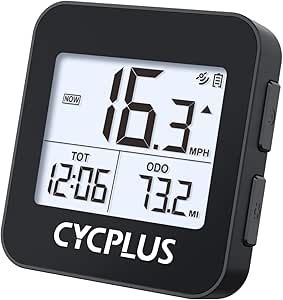 | Best Simple Long-Runtime Computer | Display: 2-inch backlit LED | Battery capacity: 1200 mAh lithium polymer | Battery life: 50 hours average; over 55 hours stated | VIEW LATEST PRICE | See Our Full Breakdown |
| Garmin Edge 840 GPS Cycling Computer |  | Best for Training-Focused Riders | Screen: 2.6-inch LCD, 240 x 320 resolution | Battery life: Up to 26 hours; up to 32 hours in battery saver mode | Storage: 32 GB | VIEW LATEST PRICE | See Our Full Breakdown |
| Garmin Edge Explore 2 GPS Cycling Navigator |  | Best for Easy-to-Read Navigation | Screen: 3-inch capacitive touchscreen | Battery life: Up to 16 hours | Storage: 16 GB | VIEW LATEST PRICE | See Our Full Breakdown |
| GEOID CC700 Wireless GPS Bike Computer with 2.8-Inch Color Display |  | Best for Indoor-and-Outdoor Versatility | Display: 2.8-inch color screen with Asahi glass | Positioning: GPS, BeiDou, GLONASS, QZSS, and Galileo | Connectivity: Wi-Fi, Bluetooth, and ANT+ | VIEW LATEST PRICE | See Our Full Breakdown |
| iGPSPORT BSC500 Touchscreen GPS Bike Computer with Map and Voice Navigation |  | Best for Large-Screen Route Guidance | Display: 3.3-inch touchscreen | Positioning: Dual-band L1/L5; GPS, BeiDou, GLONASS, Galileo, and QZSS | Controls: Touchscreen and buttons | VIEW LATEST PRICE | See Our Full Breakdown |
| Wahoo ELEMNT BOLT V3 GPS Bike Computer |  | Best Compact Option | Display: Color screen; listed as 2.2 inches in the description and 2.3 inches in product information | Battery life: Listed as 15 hours in the description and 20 hours in product information | Memory: 16 GB | VIEW LATEST PRICE | See Our Full Breakdown |
| GPS bike computer | Connectivity | Display | Battery life | Weight |
|---|---|---|---|---|
| iGPSPORT BSC300T Wireless GPS | ANT+, Bluetooth 5.0, USB Type-C | 2.4-inch capacitive touchscreen with six buttons | Up to 20 hours | 67 g |
| Magene C506 GPS Bike Computer | ANT+, Bluetooth, Wi-Fi | 2.4-inch capacitive color LCD touchscreen | Up to 24 hours in endurance mode | 76 g |
| Garmin Edge 1040 Solar GPS Bik | Bluetooth, USB | 3.5-inch LCD, 282 × 470 resolution | 30 hours average; up to 100 hours in battery-saver mode | 4.7 ounces |
| COOSPO CS600 Color Touchscreen | Bluetooth, ANT+ | 2.4-inch color LCD touchscreen | Up to 36 hours | 120 g |
| GEOID CC700 Pro GPS Bike Compu | ANT+, Bluetooth, Wi-Fi | 2.8-inch color TFT touchscreen | — | 0.22 kg |
| Hammerhead Karoo GPS Bike Comp | ANT+, BLE, USB | 3.2-inch LCD touchscreen | Up to 15 hours | 0.41 kg |
| iGPSPORT BSC200S GPS Bike Comp | ANT+, Bluetooth, USB | 2.4-inch color screen, 320 × 240 resolution | Up to 25 hours | 66 g or 67 g, as listed |
| Garmin Edge 540 GPS Cycling Co | Bluetooth, Wi-Fi, USB | — | Up to 26 hours; up to 42 hours in battery saver mode | — |
| Garmin Edge 1050 Premium Cycli | Bluetooth, USB, Wi-Fi | — | Up to 20 hours in demanding use; up to 60 hours in battery saver mode | — |
| CYCPLUS G1 Wireless GPS Bike C | Wireless | 2-inch backlit LED | 50 hours average; over 55 hours stated | 70 g |
| Garmin Edge 840 GPS Cycling Co | Bluetooth, USB, and Wi-Fi | — | Up to 26 hours; up to 32 hours in battery saver mode | — |
| Garmin Edge Explore 2 GPS Cycl | Bluetooth and Wi-Fi | LCD or LED | Up to 16 hours | — |
| GEOID CC700 Wireless GPS Bike | Wi-Fi, Bluetooth, and ANT+ | 2.8-inch color screen with Asahi glass | — | 0.21 kg |
| iGPSPORT BSC500 Touchscreen GP | — | 3.3-inch touchscreen | — | 107 g |
| Wahoo ELEMNT BOLT V3 GPS Bike | Bluetooth Smart, ANT+, Wi-Fi, and USB | Color screen; listed as 2.2 inches in the description and 2.3 inches in product information | Listed as 15 hours in the description and 20 hours in product information | 84 g |
More Details on Our Top Picks
iGPSPORT BSC300T Wireless GPS Bike Computer with Touchscreen and Offline Maps
The iGPSPORT BSC300T makes a strong case for riders who want navigation and a broad set of ride stats in a compact unit. Its offline maps, route prompts, and off-course warnings help keep a planned ride usable when a phone signal is unreliable, while tracking more than 130 metrics gives data-focused cyclists plenty to examine. The touchscreen is backed by six physical buttons, a useful pairing when rain or gloves make touch controls less convenient. Compared with the Magene C506, the BSC300T lists more satellite systems and offline maps, while Magene adds Wi-Fi and a longer stated endurance-mode runtime. The tradeoffs are a 20-hour battery ceiling and a charging cable that is not included. Some sensor connections also depend on the right protocol, so check compatibility before buying.
Pros:- Offline maps, route prompts, and off-course warnings support turn-by-turn route following.
- Tracks more than 130 riding metrics for data-focused training.
- ANT+ and Bluetooth support compatible sensors, smart trainers, and e-bikes.
- Real-time tracking and sharing support with Strava and Komoot.
Cons:- Battery life is stated at up to 20 hours, less than the Magene C506’s endurance-mode figure.
- Charging cable is not included.
- Some devices, such as power meters, require a specific connection protocol.
Best for: Cyclists who want offline route guidance, extensive ride metrics, and connections to compatible sensors or e-bikes in a compact computer.
Not ideal for: Riders planning frequent very long outings who want more than 20 hours of stated battery life, or buyers who expect a charging cable in the box.
- Display:2.4-inch capacitive touchscreen with six buttons
- Dimensions:82 × 53 × 14.1 mm
- Weight:67 g
- Battery life:Up to 20 hours
- Storage:8 GB
- Connectivity:ANT+, Bluetooth 5.0, USB Type-C
- Satellite systems:GPS, BeiDou, GLONASS, Galileo, QZSS
- Mounting:Handlebar mount
- Charging cable:Not included
Our verdict“Choose the BSC300T if offline guidance and a wide range of ride metrics matter more to you than maximum battery life or included charging accessories.”
Magene C506 GPS Bike Computer with 2.4-Inch Color Touchscreen
The Magene C506 suits riders who want one computer for outdoor routes and connected indoor sessions. Its ANT+, Bluetooth, and Wi-Fi cover a broad mix of compatible sensors and devices, including smart trainers, radar, and electronic shifting; Wi-Fi also gives it a connection option the iGPSPORT BSC300T does not list. Downloadable maps, turn-by-turn directions, and GPX route support address the core navigation needs of a ride, while smart-light control and phone notifications extend its role beyond basic recording. The stated up-to-24-hour endurance-mode battery life is longer than the BSC300T’s figure, though it applies to that mode rather than every use case. Some features rely on the OnelapFit app, adding a software dependency. Choose this over the COOSPO CS600 if connectivity breadth matters more than its longer stated battery life.
Pros:- ANT+, Bluetooth, and Wi-Fi support a wide range of compatible cycling devices.
- Downloadable maps, turn-by-turn directions, and GPX route support aid route following.
- Indoor training features complement outdoor ride recording.
- Endurance mode is rated for up to 24 hours of battery life.
Cons:- Some features require the OnelapFit app.
- The 24-hour figure is specific to endurance mode.
- Its stated battery life is shorter than the COOSPO CS600’s up-to-36-hour figure.
Best for: Road cyclists who switch between GPS-guided outdoor rides and smart-trainer workouts and want broad sensor and device compatibility.
Not ideal for: Riders who prefer a computer with fewer app dependencies or who want a stated battery runtime longer than 24 hours.
- Display:2.4-inch capacitive color LCD touchscreen
- Weight:76 g
- Battery life:Up to 24 hours in endurance mode
- Connectivity:ANT+, Bluetooth, Wi-Fi
- Navigation:GPS, downloadable maps, turn-by-turn directions, GPX routes
- Mounting:Handlebar mount
- Compatible devices:Speed and cadence sensors, heart rate monitors, power meters, smart trainers, radar and smart tail lights, electronic shifting systems
- Additional functions:Indoor training, smart-light control, phone notifications
Our verdict“Pick the C506 if you want a versatile computer for both sensor-rich outdoor rides and indoor training, and are comfortable using its companion app.”
Garmin Edge 1040 Solar GPS Bike Computer
The Garmin Edge 1040 Solar is the endurance-focused choice in this group. Its 30-hour average runtime, up to 100 hours in battery-saver mode, and solar charging support riders who spend long stretches away from a charger. The 3.5-inch display also gives maps and ride information more room than the 2.4-inch screens on the Magene C506 and iGPSPORT BSC300T. Multi-band GNSS adds a positioning advantage on routes where reliable location data matters, and the unit combines touchscreen input with buttons. It is a more substantial, feature-rich option than those compact computers, but solar gains depend on the stated continuous 75,000-lux conditions—not every ride will deliver that exposure. Some performance features also need compatible sensors, so the computer alone may not provide every data point a training-focused rider wants.
Pros:- 30-hour average battery life and up to 100 hours in battery-saver mode suit extended outings.
- Solar charging can add power under the specified bright-light conditions.
- Multi-band GNSS supports enhanced positioning accuracy.
- Large 3.5-inch display provides more space for navigation and ride data than the 2.4-inch Magene C506.
Cons:- Solar charging claims assume continuous 75,000-lux daytime conditions.
- Some performance features require compatible sensors.
- At 4.7 ounces, it is heavier than the iGPSPORT BSC300T.
Best for: Endurance cyclists and bikepackers who want a large navigation display, long battery options, and multi-band satellite positioning.
Not ideal for: Riders seeking a compact, light computer for short rides, or buyers counting on solar charging to extend runtime in all weather and light conditions.
- Display:3.5-inch LCD, 282 × 470 resolution
- Battery life:30 hours average; up to 100 hours in battery-saver mode
- Battery type:Lithium polymer
- Connectivity:Bluetooth, USB
- Input:Buttons and touchscreen
- Dimensions:2.3 × 0.8 × 4.6 inches
- Weight:4.7 ounces
- Water resistance:IPX7
- Mounting:Handlebar mount
Our verdict“Choose the Edge 1040 Solar if long ride time and a large navigation display outweigh its size and dependence on suitable sunlight for solar gains.”
COOSPO CS600 Color Touchscreen GPS Bike Computer
The COOSPO CS600 stands out for riders who value fewer charging stops over a long list of connected extras. Its up-to-36-hour battery life exceeds the stated endurance-mode runtime of the Magene C506 and is useful for multi-day riding or frequent recording between charges. The 2.4-inch color touchscreen offers breadcrumb route guidance, while IPX7 water resistance suits wet-weather use. Bluetooth and ANT+ cover connections to compatible cycling devices and apps, but the description does not specify the broad device list or Wi-Fi found on the C506. At 120 g, it is also heavier than both the C506 and iGPSPORT BSC300T. Sensors and extension mounts are sold separately, so buyers building a complete setup should account for those missing extras. It is a battery-first option, not the lightest or most connected pick here.
Pros:- Up to 36 hours of battery life is the longest stated runtime among these five products.
- IPX7 water resistance suits rides in wet conditions.
- Breadcrumb guidance provides route navigation.
- Bluetooth and ANT+ support compatible devices and apps.
Cons:- At 120 g, it is heavier than the Magene C506 and iGPSPORT BSC300T.
- Additional sensors and extension mounts are sold separately.
- The listed navigation is breadcrumb guidance, rather than the downloadable maps and turn-by-turn directions specified for the Magene C506.
Best for: Touring and endurance riders who want long stated battery life, basic breadcrumb navigation, and wet-weather protection.
Not ideal for: Weight-conscious cyclists or riders who want downloadable maps, detailed turn-by-turn routing, or extra sensors and mounts included.
- Display:2.4-inch color LCD touchscreen
- Battery life:Up to 36 hours
- Water resistance:IPX7
- Connectivity:Bluetooth, ANT+
- Satellite systems:GPS, GLONASS
- Weight:120 g
- Mounting:Handlebar mount
- Charging:USB Type-C
- Included components:Computer, anti-loss rope, mounting base, Type-C cable, user manual
Our verdict“Choose the CS600 if long battery life and weather protection matter more than low weight, included sensors, or richer navigation features.”
GEOID CC700 Pro GPS Bike Computer with 2.8-Inch Color Touchscreen
The GEOID CC700 Pro is the map-focused pick for riders who want more display space and route recovery tools without stepping up to the much larger Garmin Edge 1040 Solar. Its 2.8-inch color touchscreen is larger than the 2.4-inch screens on the Magene C506 and iGPSPORT BSC300T, giving maps more room to read. Offline maps, route recalculation, and support for five satellite systems make it well suited to exploring unfamiliar roads; Wi-Fi and Bluetooth handle ride-data and AGNSS syncing. The CC700 Pro also supports ANT+ sensors, smart trainers, Strava, TrainingPeaks, and select DJI cameras. There are catches: route recalculation requires the designated app, and DJI controls work only with Action 4 and Action 5 Pro. Its listed weight of 0.22 kg is also notably higher than the compact alternatives.
Pros:- 2.8-inch color touchscreen offers more map space than the 2.4-inch Magene C506.
- Offline maps and route recalculation help with unfamiliar routes.
- Five satellite systems and Wi-Fi AGNSS syncing support location and data updates.
- ANT+ sensors, smart trainers, Strava, and TrainingPeaks are supported.
Cons:- Route recalculation requires connection to the designated app.
- DJI camera controls work only with Action 4 and Action 5 Pro.
- Listed weight is 0.22 kg, substantially more than the iGPSPORT BSC300T’s 67 g.
Best for: Riders exploring unfamiliar routes who want a larger touchscreen, offline maps, and route recalculation alongside broad training-service support.
Not ideal for: Weight-conscious riders, cyclists who want route recalculation without a phone-app connection, or camera owners outside the supported DJI models.
- Display:2.8-inch color TFT touchscreen
- Storage:4 GB
- Connectivity:ANT+, Bluetooth, Wi-Fi
- Satellite systems:GPS, BeiDou, GLONASS, QZSS, Galileo
- Water resistance:IPX7
- Battery type:Lithium-ion
- Dimensions:2.24 × 0.76 × 3.78 inches
- Weight:0.22 kg
- Compatible services and cameras:Strava, TrainingPeaks; DJI Action 4 and Action 5 Pro
Our verdict“Pick the CC700 Pro if you want a larger screen and offline mapping for route exploration, and can accept app-dependent recalculation and a heavier unit.”
Hammerhead Karoo GPS Bike Computer
The Hammerhead Karoo makes the most sense for riders who want a large touchscreen and direct links to a connected bike setup. Its 3.2-inch display gives routes and ride data more room than the Garmin Edge 540’s 2.6-inch screen, while multi-band GNSS supports precise tracking. Button controls add an alternative to touch input, which is useful when conditions make a touchscreen less convenient. Compatibility with SRAM AXS, e-bikes, ANT+ lights, and other devices gives it a clear place in an integrated cockpit.
The tradeoff is endurance: up to 15 hours is shorter than the iGPSPORT BSC200S’s stated 25 hours, so frequent long rides may mean more charging. I’d choose the Karoo for its screen and connectivity, not for maximum battery life.
Pros:- Multi-band GNSS supports accurate ride tracking.
- Large 3.2-inch touchscreen gives routes and data generous space.
- Buttons provide an alternative to touchscreen input.
- Connects with SRAM AXS, e-bikes, ANT+ lights, and other devices.
Cons:- Up to 15 hours of battery life is shorter than the iGPSPORT BSC200S’s stated runtime.
- Its larger screen and feature set may be more than riders seeking a simple metrics display need.
Best for: Riders with SRAM AXS or compatible connected equipment who want a large route display and both touch and button controls.
Not ideal for: Riders doing frequent all-day or multi-day rides who want longer battery life between charges.
- Display:3.2-inch LCD touchscreen
- Battery life:Up to 15 hours
- Navigation:Multi-band GNSS
- Connectivity:ANT+, BLE, USB
- Controls:Buttons and touchscreen
- Mounting:Handlebar mount
- Dimensions:8 × 5 × 3 inches
- Weight:0.41 kg
Our verdict“Choose the Karoo for a large, connected cycling display, but pick the iGPSPORT BSC200S if longer stated battery life matters more.”
iGPSPORT BSC200S GPS Bike Computer with Route Navigation
The iGPSPORT BSC200S pairs route tools with a notably long stated runtime, making it a practical pick for riders who want navigation without stepping up to the larger Garmin Edge 1050. Its up to 25 hours of battery life outlasts the Hammerhead Karoo’s stated 15 hours, while its 2.4-inch color screen keeps the device compact at just 66–67 g. Route creation, imported routes, and one-touch navigation suit riders who regularly follow planned courses rather than only recording familiar rides.
It also supports ANT+ and Bluetooth sensors and stores up to 400 hours of ride data. The compromise is a smaller display than premium models, and the USB Type-C cable is not included. I’d favor it over the CYCPLUS G1 when route guidance matters; the CYCPLUS is simpler and lists longer runtime, but provides fewer stated navigation tools.
Pros:- Up to 25 hours of stated battery life.
- Supports route creation, imported routes, and one-touch navigation.
- ANT+ and Bluetooth support speed, cadence, heart rate, and power sensors.
- IPX7 water resistance and storage for up to 400 hours of riding data.
Cons:- The 2.4-inch screen is smaller than the Hammerhead Karoo and Garmin Edge 1050 displays.
- USB Type-C charging cable is not included.
- Listed weight varies between 66 g and 67 g.
Best for: Route-focused recreational riders who want sensor support, a light device, and long battery life without a large screen.
Not ideal for: Riders who prioritize a large, detailed map display or expect a charging cable to be included.
- Display:2.4-inch color screen, 320 × 240 resolution
- Battery life:Up to 25 hours
- Connectivity:ANT+, Bluetooth, USB
- Data storage:Up to 400 hours of riding data
- Sensor support:Speed, cadence, heart rate, and power sensors
- Water resistance:IPX7
- Charging interface:USB Type-C
- Weight:66 g or 67 g, as listed
Our verdict“Pick the BSC200S for compact route guidance and long stated runtime, rather than a premium-sized map screen.”
Garmin Edge 540 GPS Cycling Computer
The Garmin Edge 540 is the training-focused choice here for riders who prefer physical controls and want navigation paired with workout guidance. Its adaptive coaching, suggested workouts, and training insights go beyond the CYCPLUS G1’s core ride metrics, while multi-band GNSS and ride-specific maps support course planning. ClimbPro can show ascent details even when a ride does not follow a saved course, a useful distinction for riders who want climb information on spontaneous outings.
Battery life is another advantage: Garmin lists up to 26 hours in demanding use and 42 hours in battery saver mode, exceeding the Hammerhead Karoo’s stated maximum. The 2.6-inch screen is button-controlled, however, so riders who favor touch-based map interaction may prefer the Garmin Edge 1050. Some coaching and performance features also depend on compatible sensors, including a power meter and heart rate monitor.
Pros:- Multi-band GNSS supports enhanced positioning accuracy.
- Adaptive coaching, suggested workouts, and training insights add structure to rides.
- ClimbPro can provide ascent planning without a saved course.
- Battery life reaches up to 42 hours in battery saver mode.
Cons:- Button-only input may feel less direct for riders who prefer touchscreen maps.
- Some training and performance features require a compatible power meter and heart rate monitor.
Best for: Training-minded cyclists who want Garmin workout guidance, climb data, and long battery options with physical button controls.
Not ideal for: Riders who want touchscreen operation or expect every training metric to work without compatible sensors.
- Screen:2.6-inch LCD, 246 × 322 resolution
- Controls:Buttons
- Battery life:Up to 26 hours; up to 42 hours in battery saver mode
- Storage:16 GB
- Connectivity:Bluetooth, Wi-Fi, USB
- Navigation:Multi-band GNSS and ride-specific maps
- Map coverage:North America
- Mounting:Handlebar mount
Our verdict“Choose the Edge 540 for button-based navigation and training tools; choose the Edge 1050 if a large touchscreen is your priority.”
Garmin Edge 1050 Premium Cycling Computer
The Garmin Edge 1050 is the premium pick for riders who want a large map and ride interface on the handlebar. Its 3.5-inch color touchscreen is larger than the Hammerhead Karoo’s 3.2-inch display and supports on-device course creation, making route edits easier to handle on the unit itself. A built-in speaker adds spoken prompts and a bike bell, while connected ride features and training guidance broaden its role beyond navigation.
Battery life reaches up to 60 hours in battery saver mode, though Garmin lists up to 20 hours in demanding use—less than the Edge 540’s 26-hour demanding-use figure. That difference makes the 1050 more appealing for screen-forward convenience than maximum runtime with all features active. Some connected features need a compatible smartphone and Garmin Connect app; personalized training also requires compatible sensors.
Pros:- Large 3.5-inch capacitive touchscreen supports on-device course creation and map viewing.
- Battery saver mode offers up to 60 hours of use.
- Built-in speaker provides prompts and a bike bell.
- Combines navigation, training guidance, and cycling performance features.
Cons:- Up to 20 hours in demanding use is less than the Edge 540’s listed 26 hours.
- Some connected features require a compatible smartphone and Garmin Connect app.
- Personalized training features require a compatible power meter and heart rate monitor.
Best for: Dedicated cyclists who want a large touchscreen for route viewing and editing, plus connected features and a built-in speaker.
Not ideal for: Riders seeking a smaller, button-only computer or the longest listed runtime during demanding use.
- Screen:3.5-inch LCD capacitive touchscreen
- Battery life:Up to 20 hours in demanding use; up to 60 hours in battery saver mode
- Storage:64 GB
- Connectivity:Bluetooth, USB, Wi-Fi
- Satellite systems:GPS, GLONASS, Galileo
- Map coverage:North America
- Audio:Built-in speaker
- Controls:Buttons and touchscreen
Our verdict“Choose the Edge 1050 when a large touchscreen and on-device route control matter more than a smaller unit or longer demanding-use runtime.”
CYCPLUS G1 Wireless GPS Bike Computer
The CYCPLUS G1 is the straightforward choice for riders who mainly need GPS ride recording and core metrics, rather than mapped route guidance or training plans. Its 2-inch backlit screen shows ride time, distance, total mileage, clock, and altitude, while the IPX6 water resistance provides protection for wet-weather use. Compared with the iGPSPORT BSC200S, it has fewer stated navigation features and no listed ANT+ or Bluetooth sensor support, but it offers a simpler setup and a much longer claimed runtime.
Battery figures are not fully consistent: the listing gives 50 hours average and also states over 55 hours. I’d treat that as a long-runtime claim rather than a precise expectation. The compact display and basic feature set are sensible for recording familiar rides, but riders following courses are better served by the BSC200S or a Garmin model with maps and training tools.
Pros:- GPS tracks routes and displays ride time, distance, total mileage, clock, and altitude.
- Backlit 2-inch screen is designed for visibility in sunlight.
- IPX6 water resistance suits riding in wet conditions.
- Long stated battery runtime, with a 1200 mAh battery.
Cons:- Battery life is listed as both 50 hours average and over 55 hours.
- The supplied information does not list route navigation or ANT+ and Bluetooth sensor support.
- Its basic feature set offers less than the route and training tools on the Garmin Edge 540.
Best for: Cyclists who want a compact GPS computer for recording familiar rides and viewing basic metrics with infrequent charging.
Not ideal for: Riders who need route navigation, compatible sensor connections, or advanced training features.
- Display:2-inch backlit LED
- Battery capacity:1200 mAh lithium polymer
- Battery life:50 hours average; over 55 hours stated
- Water resistance:IPX6
- Connectivity:Wireless
- Weight:70 g
- Mounting:Handlebar mount
- Warranty:Two years
Our verdict“Choose the CYCPLUS G1 for simple ride recording and a long stated runtime, but look to the BSC200S for route guidance and sensor support.”
Garmin Edge 840 GPS Cycling Computer
The Edge 840 is the strongest fit here for riders who want navigation and structured performance guidance in one compact unit. Its touchscreen and physical buttons give you two ways to control it, while multi-band GNSS can help maintain positioning accuracy on routes where satellite reception is difficult. Compared with the navigation-first Garmin Edge Explore 2, the 840 puts more emphasis on adaptive coaching and performance insights; that makes it a better match for riders who track progress, not just directions. Battery life is also a clear advantage over the Explore 2, reaching up to 26 hours or 32 in battery saver mode. The tradeoff is that some training metrics depend on separate heart rate and power sensors, and its 2.6-inch screen is smaller than the Explore 2’s.
Pros:- Touchscreen and buttons offer flexible control while riding
- Multi-band GNSS supports more accurate positioning
- Adaptive coaching and performance insights add training value
- Up to 32 hours in battery saver mode suits longer rides
Cons:- Some performance and training features require a compatible power meter and heart rate monitor
- The 2.6-inch screen is smaller than the Edge Explore 2’s 3-inch display
Best for: Road and gravel riders who want detailed training guidance, reliable route positioning, and long battery life in a compact computer.
Not ideal for: Casual riders who mainly need a large, easy-to-read navigation screen and do not plan to use training features or compatible sensors.
- Screen:2.6-inch LCD, 240 x 320 resolution
- Battery life:Up to 26 hours; up to 32 hours in battery saver mode
- Storage:32 GB
- Controls:Touchscreen and buttons
- Connectivity:Bluetooth, USB, and Wi-Fi
- Navigation:GPS; North America map region
- Mounting:Handlebar mount
Our verdict“Choose the Edge 840 if training tools and long battery life matter more to you than the larger screen of the Edge Explore 2.”
Garmin Edge Explore 2 GPS Cycling Navigator
The Edge Explore 2 prioritizes route guidance over training analysis, and its 3-inch touchscreen makes that choice clear: the larger map is easier to read at a glance than the Edge 840’s 2.6-inch screen. Preloaded road and off-road maps, turn-by-turn directions, and eBike guidance make it especially useful for exploring unfamiliar routes without turning the computer into a training dashboard. Connected safety features such as LiveTrack and incident detection add reassurance for riders who share their plans. Compared with the iGPSPORT BSC500, the Explore 2 has a shorter stated battery life of up to 16 hours, but its eBike-specific guidance is a more defined advantage. Sensor support is available, though heart rate, speed, and cadence sensors are sold separately, and some connected functions need a phone and network coverage.
Pros:- Large 3-inch touchscreen gives maps more room than the Edge 840’s display
- Preloaded road and off-road maps support route exploration
- eBike guidance can use battery status, assist level, and range
- Incident detection and LiveTrack add connected safety options
Cons:- Stated battery life is up to 16 hours
- Heart rate, speed, and cadence sensors are sold separately
- Some connected features depend on a compatible smartphone and network coverage
Best for: Touring, recreational, and eBike riders who value a large map, straightforward directions, and connected safety features over advanced training analysis.
Not ideal for: Long-distance riders who need more than 16 hours of stated battery life or training-focused cyclists seeking built-in performance coaching.
- Screen:3-inch capacitive touchscreen
- Battery life:Up to 16 hours
- Storage:16 GB
- Display:LCD or LED
- Connectivity:Bluetooth and Wi-Fi
- Navigation:GPS with bike-specific maps and turn-by-turn guidance
- Profiles:Road, off-road, and indoor activity profiles
Our verdict“Pick the Edge Explore 2 if a clear navigation screen and eBike route guidance matter more than the Edge 840’s training features and longer battery life.”
GEOID CC700 Wireless GPS Bike Computer with 2.8-Inch Color Display
The GEOID CC700 stands out for riders who want one computer for mapped outdoor routes and smart-trainer sessions. Its color navigation with turn reminders and automatic rerouting gives it more route flexibility than a basic data-only unit, while support for GPS, BeiDou, GLONASS, QZSS, and Galileo offers a broad set of positioning systems. The 108 supported data items and customizable pages also let riders tailor what appears on screen. Compared with the Wahoo ELEMNT BOLT V3, the CC700 adds indoor smart-trainer workouts with adjustable power, resistance, and gradient; the BOLT V3, in turn, is lighter at 84 g versus the CC700’s 210 g. AGNSS speeds acquisition only when its data is current, so riders need to sync periodically, and the 2.8-inch screen may feel cramped to anyone who prefers a larger map.
Pros:- Color route guidance includes turn reminders and automatic rerouting
- GPS, BeiDou, GLONASS, QZSS, and Galileo positioning support
- Wi-Fi, Bluetooth, and ANT+ connect a broad range of devices
- Smart-trainer workouts support customizable power, resistance, and gradient
Cons:- Fast GPS acquisition relies on AGNSS data that must be refreshed through syncing
- At 0.21 kg, it weighs more than the 84 g Wahoo ELEMNT BOLT V3
- The 2.8-inch screen may feel small for riders who prioritize map visibility
Best for: Riders who alternate between outdoor route navigation and indoor smart-trainer workouts, and who want broad sensor connectivity and customizable data pages.
Not ideal for: Weight-conscious riders or cyclists who prefer a larger display and do not want to sync AGNSS data periodically for faster positioning.
- Display:2.8-inch color screen with Asahi glass
- Positioning:GPS, BeiDou, GLONASS, QZSS, and Galileo
- Connectivity:Wi-Fi, Bluetooth, and ANT+
- Data fields:108 supported data items; up to 10 pages and 10 items per page
- Device connections:Up to 9 types of devices
- Weight:0.21 kg
- Water resistance:IPX7
- Indoor training:Smart-trainer workouts with customizable power, resistance, and gradient
Our verdict“Choose the CC700 if indoor trainer control and broad device support matter more than the lighter build of the Wahoo ELEMNT BOLT V3.”
iGPSPORT BSC500 Touchscreen GPS Bike Computer with Map and Voice Navigation
The iGPSPORT BSC500 is the large-screen navigation choice in this group: its 3.3-inch touchscreen gives routes and up to 12 data points per page plenty of space, while buttons provide another way to operate the unit. Route imports, automatic rerouting, climb previews, and voice navigation make it suited to riders who follow planned courses but may need to adjust mid-ride. Its dual-band L1/L5 positioning and support for five satellite systems give it a strong navigation specification beside the GEOID CC700, whose screen is 2.8 inches and whose positioning does not list dual-band reception. The BSC500’s main limitation is uncertainty: no battery runtime is provided, so it is harder to match confidently to long rides. The listed package also does not include a cadence sensor.
Pros:- 3.3-inch touchscreen provides more map and data space than the GEOID CC700
- Touchscreen and buttons give riders two control methods
- Dual-band L1/L5 positioning supports multiple satellite systems
- Route imports, automatic rerouting, voice guidance, and climb previews aid route following
Cons:- No battery runtime information is provided
- No included cadence sensor is listed
Best for: Riders who want a large, information-rich display for imported routes, turn alerts, climb previews, and voice guidance.
Not ideal for: Riders planning long events who need a confirmed battery runtime, or buyers expecting a cadence sensor to be included.
- Display:3.3-inch touchscreen
- Positioning:Dual-band L1/L5; GPS, BeiDou, GLONASS, Galileo, and QZSS
- Controls:Touchscreen and buttons
- Data display:Up to 12 cycling data points per page
- Weight:107 g
- Water resistance:IPX7
- Navigation:Route imports, turn alerts, automatic rerouting, and voice navigation
- Battery:Lithium-ion; runtime not provided
Our verdict“Pick the BSC500 if a large, feature-rich navigation display is your priority and the missing battery runtime information is acceptable.”
Wahoo ELEMNT BOLT V3 GPS Bike Computer
The Wahoo ELEMNT BOLT V3 is the compact, button-controlled choice for riders who want dependable route features without a large touchscreen unit. At 84 g, it is substantially lighter than the GEOID CC700, while still offering on-device turn-by-turn directions, route syncing, and rerouting. Bluetooth Smart, ANT+, and Wi-Fi support sensor and service connections, and USB-C keeps charging straightforward. Compared with the Garmin Edge 840, the BOLT V3 has a smaller 2.2-inch display according to the product description and lacks the listed adaptive coaching emphasis; its appeal is a simpler navigation-focused setup. Published product details conflict on both screen size and battery life, listing 2.2 versus 2.3 inches and 15 versus 20 hours. Buyers who need a firm runtime or phone-free LiveTrack should look elsewhere.
Pros:- Light 84 g body is easier to fit into a compact cockpit than the GEOID CC700
- On-device turn-by-turn directions include rerouting
- Bluetooth Smart, ANT+, and Wi-Fi support sensors and route services
- USB-C charging and customizable data pages add practical flexibility
Cons:- Product information conflicts on display size and battery life
- Smart notifications and LiveTrack require a smartphone during the ride
- The compact display offers less map area than the Garmin Edge Explore 2
Best for: Weight-conscious road cyclists who want button-based route guidance, sensor pairing, and a compact handlebar setup.
Not ideal for: Riders who need a large map, a confirmed battery runtime, or connected features such as LiveTrack without carrying a smartphone.
- Display:Color screen; listed as 2.2 inches in the description and 2.3 inches in product information
- Battery life:Listed as 15 hours in the description and 20 hours in product information
- Memory:16 GB
- Weight:84 g
- Connectivity:Bluetooth Smart, ANT+, Wi-Fi, and USB
- Charging:USB-C
- Water resistance:IPX7
- Navigation:On-device turn-by-turn directions, route downloads, and rerouting
Our verdict“Choose the BOLT V3 if low weight and button-operated navigation matter more than a larger display or unambiguous battery specifications.”

How We Picked
I compared these computers around the decisions that matter on a bike: route guidance and mapping, visibility and control, battery and build considerations, training and sensor support, and how much complexity each device asks of its owner. I treated a large screen as useful only when it helped riders follow routes or read data, and considered touchscreen operation alongside button controls rather than assuming one is always better. Since the lineup spans basic GPS units, navigation-focused models, and feature-heavy training computers, I also weighed whether each device’s capabilities match a clear rider need.
The ranking favors all-around usefulness for a broad range of cyclists, then distinguishes specialized picks by their strongest use case. That puts the Edge 840 at the top for its balance, while the Edge 1050 and Edge 1040 Solar rank as premium alternatives for buyers who value their particular display or endurance features. More affordable or focused units remain worthwhile when their narrower feature set matches the rider; they rank lower as general recommendations because they do not aim to cover as many needs. Product specifications and feature positioning inform this comparison, not claims of hands-on testing.
Factors to Consider When Choosing Best GPS Bike Computers
Before choosing a GPS bike computer, I would start with the rides you actually do, not the longest feature list. Navigation needs, control preference, and data habits usually matter more than a single headline specification. These broader tradeoffs can help narrow the field before comparing individual models.
Match Navigation to Your Routes
Think about whether you need turn-by-turn directions, on-device maps, or only a breadcrumb-style route line. Familiar road loops may not justify paying for detailed mapping, while unfamiliar touring routes and frequent rerouting make navigation more valuable. Check how routes get onto the device and whether the computer can recalculate when you miss a turn; route creation and on-device guidance are separate parts of the experience. A screen that shows more map detail can reduce stops to check a phone, but it takes more space on the bars. Avoid buying on the word “maps” alone: confirm that the routing tools suit the places and riding conditions you use.
Choose a Screen and Controls You Can Use While Riding
A larger color display can make maps and multiple data fields easier to read, especially on long rides, but it also occupies more cockpit space. Compact units keep the handlebar setup tidy and may be easier to glance at, though small maps can be harder to follow at a junction. Touchscreens are convenient for browsing and changing views, but gloves, rain, and road vibration can affect how natural they feel to operate. Physical buttons offer a tactile alternative when conditions are poor or when you prefer not to swipe. If possible, decide which control style you can operate without taking attention from the road.
Separate Training Data from Basic Ride Recording
Many riders only need distance, speed, time, and a reliable record of each ride. Structured workouts, performance metrics, and connections to heart-rate monitors, power meters, or other sensors become more useful as training becomes part of the routine. Buying an advanced computer without compatible sensors or a plan to use its data can add complexity without changing your rides. On the other hand, a basic unit may feel limiting if you want to follow workouts or review several live metrics. List the data you use now and the tools you expect to add before paying for features you may not use.
Think Beyond a Battery-Life Headline
Advertised battery life depends on settings and conditions, so compare devices by the ride length and frequency you need rather than relying on one maximum figure. Bright displays, frequent navigation, connected sensors, and wireless features can all affect how long a computer runs between charges. Riders doing long events or multi-day trips should leave a practical buffer rather than planning around the stated limit. Solar charging can appeal to riders spending extended time outdoors, but it is not a substitute for checking charging habits and real ride requirements. Also consider whether the charging method and battery upkeep fit how you store and use your equipment.
Check Compatibility Before You Commit
A bike computer is only as useful as its fit with your current setup. Check support for your phone, preferred route-planning services, sensors, and any cycling apps you rely on. If you own several sensors or move the computer between bikes, compatibility and mounting options can matter more than a display upgrade. Some riders value a familiar ecosystem because it keeps ride data, training tools, and accessories connected; others may prefer a simpler standalone setup. Confirming these details first can prevent the frustration of buying a capable device that does not work smoothly with the rest of your kit.
Pay for the Features You Will Use
Spending more makes sense when a feature solves a recurring problem: clearer mapping for unfamiliar routes, longer endurance for extended rides, or more capable training tools for structured workouts. It is a weaker value when the extra functions are unlikely to leave the settings menu. A lower-cost GPS computer can be the sensible choice for recording regular rides and following basic routes, while a premium model suits riders who make frequent use of its richer interface or advanced tools. Account for the time needed to set up maps, data pages, and sensors, too. The right value is the device that fits your routine, not the one with the longest specification list.
Frequently Asked Questions
Is a touchscreen bike computer a better choice than a button-operated one?
Neither control style is automatically better; the right choice depends on how you ride and interact with the device. Touchscreens can make map browsing and menu changes feel direct, while buttons can be easier to operate with gloves or in wet conditions. Some options in this roundup offer touchscreen controls, while models such as the Edge 540 emphasize physical controls. Think about the tasks you perform mid-ride, not just setup at home. If you often change screens or inspect routes on the bike, control style deserves as much attention as display size.
Do I need on-device maps, or is basic route guidance enough?
Basic route guidance can work well if you follow familiar routes or load a prepared course and rarely change it. On-device maps are more useful when you explore unfamiliar roads, need context at intersections, or want to recover after taking a wrong turn. Do not assume every computer described as having navigation offers the same map detail or rerouting behavior. Consider how often you ride somewhere new and whether you are comfortable checking a phone if a route becomes unclear. For riders who value independence from a phone, stronger mapping tools are easier to justify.
Should I choose a premium computer if I only want to record rides?
Usually not unless the premium model also solves a need you have, such as clearer route visibility, a particular battery feature, or sensor and training support. For straightforward ride recording, a simpler GPS unit may provide the essential information with fewer menus to manage. Premium computers are most compelling when you regularly use their navigation, data, or display advantages. Consider the full setup too: advanced training features are less useful if you do not own compatible sensors or plan to add them. Match the device to your habits rather than buying features for hypothetical future rides.
Which features should I check if I already own cycling sensors?
Confirm that the computer supports the types of sensors you own and the wireless connections they use. Check whether it can display the metrics you care about, rather than assuming a connection alone means the data will appear in the way you want. If your sensors are part of a structured training setup, compare workout and data-field support as well as basic pairing. Consider compatibility with your phone and ride-data apps so the computer fits into your existing routine. A quick compatibility check can matter more than choosing between two screens with similar sizes.
Is a larger bike computer screen worth the extra handlebar space?
A larger screen helps when you need to read maps or several data fields at a glance, particularly on unfamiliar routes. It can be less appealing if your cockpit is crowded or you prefer a low-profile setup. Compact models such as the BOLT V3 and Edge 540 suit riders who value a smaller footprint, while larger-display computers put more information in view. Think about whether you glance at maps frequently or mostly track a few simple metrics. Your need for readable information should decide the tradeoff, not screen size by itself.
Conclusion
For most riders, I recommend the Garmin Edge 840 as the best overall choice because it balances navigation, training features, and control options. Buyers seeking a premium display and broad feature set should look at the Garmin Edge 1050, while the Garmin Edge 1040 Solar is the more specific fit for riders drawn to solar charging and long outings. For a simpler start, consider the Garmin Edge Explore 2 if route guidance is the priority, or a more basic iGPSPORT or CYCPLUS option if recording rides is enough. The Wahoo ELEMNT BOLT V3 suits riders who want a compact unit, while the Magene, GEOID, and COOSPO models offer touchscreen alternatives worth comparing by their exact mapping and setup needs. Choose by your riding pattern: training data, navigation, screen preference, and compatibility matter more than having every feature.
NFL season / tailgating Picks
team gear
As an affiliate, we earn on qualifying purchases.