I narrowed this Torque Fitness strength equipment roundup to three distinct training tools: the Relentless Rope Trainer for rack-based upper-body conditioning, the TANK M1 Push Sled for versatile pushing and pulling, and the Relentless Ripper Ski Machine for a space-conscious full-body workout. Each uses resistance differently, so the right pick depends less on a shared feature list and more on the movements you want to train.

Get sports gear delivered free with Prime
- Fast, free delivery on millions of items
- Prime Video, Amazon Music and more included
- Member-only deals all year
My best overall choice for adaptable conditioning is the TANK M1, since it supports multiple movements and can be used across different surfaces. The Ripper makes more sense if you want measured ski-erg-style workouts without dedicating floor space to a freestanding machine, while the Rope Trainer is the more focused choice for rope intervals and grip-demanding pulls. The main tradeoffs are mounting needs, workout variety, and portability: none is a universal strength station, and each asks you to have the right space or setup.
Complete the kit


Key Takeaways
- The TANK M1 is my most versatile pick for pushing and pulling drills, but its 67-pound frame can make moving it a chore.
- The Relentless Ripper has the clearest workout feedback, with 10 resistance levels and a monitor for time, pace, watts, calories, and distance.
- The Relentless Rope Trainer suits rope intervals and bidirectional pulling; it needs a compatible rack or a separately purchased wall-mount bracket.
- All three use resistance that responds to effort, but the Ripper and Rope Trainer use magnetic systems while the M1 uses a Mag-Force brake.
- Choose by your available setup: the M1 needs a suitable training surface, while the Rope Trainer and Ripper need compatible mounting points.
| Torque Fitness TANK M1 Push Sled |  | Best Overall for Versatile Conditioning | Resistance: Variable-resistance Mag-Force brake | Operation: Manual | Handle type: Removable | VIEW LATEST PRICE | See Our Full Breakdown |
| Torque Fitness Relentless Ripper Ski Machine |  | Best for Measured Full-Body Training | Resistance type: Progressive magnetic | Resistance levels: 10 | Display: LED performance monitor | VIEW LATEST PRICE | See Our Full Breakdown |
| Torque Fitness Relentless Rope Trainer |  | Best for Rack-Based Rope Intervals | Resistance type: Magnetic | Resistance levels: 4 | Operation: Manual | VIEW LATEST PRICE | See Our Full Breakdown |
| Torque Fitness strength equipment | Weight | Operation | Warranty | Resistance type |
|---|---|---|---|---|
| Torque Fitness TANK M1 Push Sl | 67 pounds | Manual | 10 years on frame and welds; 1 year on parts and workmanship | — |
| Torque Fitness Relentless Ripp | 50 pounds | — | 10 years on frame; 2 years miscellaneous; 5 years on moving structural parts | Progressive magnetic |
| Torque Fitness Relentless Rope | 45 pounds | Manual | — | Magnetic |
More Details on Our Top Picks
Torque Fitness TANK M1 Push Sled
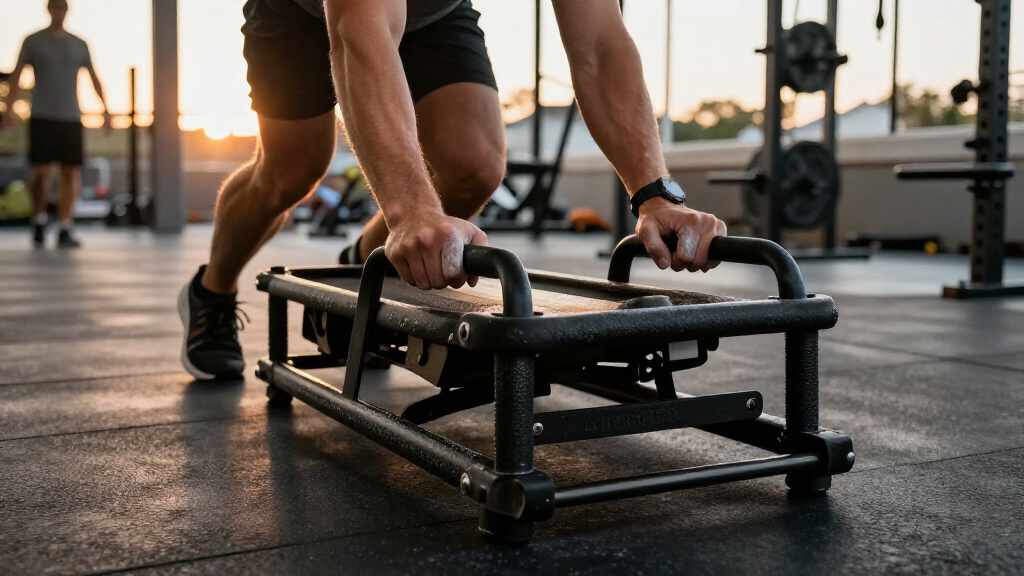
I rank the TANK M1 first for workout range. Its variable-resistance Mag-Force brake gives it a different job from the rack-mounted machines in this roundup: instead of anchoring a single pulling pattern to a frame, it lets you take a sled into pushing and pulling drills on a suitable training surface. That makes it the most adaptable option here for buyers who want to vary sessions rather than build around rope or ski movements alone.
The quiet operation is a useful detail for garage gyms and personal-training spaces where a loud sled can be disruptive. Removable handles also make storage and transport easier than they would be with a fixed-handle design. Still, “easier” does not mean lightweight: at 67 pounds, the M1 is heavier than the Rope Trainer and Ripper, so frequent loading into a vehicle or carrying up steps may feel impractical.
Compared with the Ripper, the M1 gives up built-in workout metrics and a set of defined resistance levels, but gains flexibility across movements and surfaces. Compared with the Rope Trainer, it needs no rack attachment to perform its core sled function, though it does need room to move. Pick it for adaptable sled work; skip it if you want a fixed, compact station with a monitor or have no suitable path for pushing and pulling.
Pros:- Variable-resistance Mag-Force brake supports changing workout demands.
- Quiet operation suits shared or home training spaces.
- Removable handles help with storage and transport.
- Designed for multiple surfaces and a range of sled movements.
Cons:- At 67 pounds, it may be cumbersome to move despite its removable handles.
- Needs a suitable surface and enough clear space for sled training.
- No performance monitor is listed among the included features.
Best for: Garage-gym owners, trainers, and conditioning-focused buyers who want a quiet sled for varied pushing and pulling drills on suitable surfaces.
Not ideal for: Buyers with little clear floor space, anyone who needs to carry equipment often, or shoppers seeking a mounted machine with built-in workout tracking.
- Resistance:Variable-resistance Mag-Force brake
- Operation:Manual
- Handle type:Removable
- Weight:67 pounds
- Material:Alloy steel
- Color:Black
- Warranty:10 years on frame and welds; 1 year on parts and workmanship
- Included components:M1 sled
Our verdict“I recommend the TANK M1 as the most versatile pick here if you have space for sled work and can manage its weight.”
Torque Fitness Relentless Ripper Ski Machine
The Relentless Ripper is the strongest choice for structured ski-machine workouts. Its 10 levels of progressive magnetic resistance give buyers more adjustment steps than the Rope Trainer’s four levels, and its LED monitor records time, strokes per minute, watts, calories, and distance. That feedback is useful if you like to compare intervals or track a session’s pace instead of relying only on how hard a set feels.
Its mounting options are another differentiator. The Ripper can attach to a wall, rack, or rig, which gives it more installation flexibility than the Rope Trainer, whose listed compatibility centers on racks and rigs with tubing up to 6 by 6 inches. Both save floor space compared with a freestanding machine, but the Ripper’s 24.5-by-21-by-39.1-inch footprint and 50-pound weight still call for a secure mounting surface and careful installation. It also needs corded electric power, so the chosen location must accommodate that requirement.
Ergonomic grips support single- and double-pole movements, making the machine suitable for varied ski-style pulling rather than only one fixed hand position. Compared with the TANK M1, the Ripper offers much clearer performance tracking and a defined movement pattern, but it cannot match the sled’s versatility across different drills and surfaces. Choose the Ripper for trackable, low-impact conditioning; look elsewhere if you need an unmounted sled or want the broadest range of exercise types.
Pros:- Ten progressive magnetic resistance levels allow fine adjustment between sessions.
- Monitor tracks time, strokes per minute, watts, calories, and distance.
- Can mount to a wall, rack, or rig to preserve floor space.
- Ergonomic grips support single- and double-pole movements.
Cons:- The 50-pound unit may be difficult to position during installation.
- Requires a compatible mounting surface or system.
- Corded electric power limits placement options.
Best for: Buyers who want low-impact, full-body ski-style conditioning, multiple resistance settings, and workout metrics in a wall-, rack-, or rig-mounted setup.
Not ideal for: Anyone without a suitable mounting surface or access to corded power, or buyers whose priority is sled pushing and varied floor-based drills.
- Resistance type:Progressive magnetic
- Resistance levels:10
- Display:LED performance monitor
- Tracked metrics:Time, strokes per minute, watts, calories, and distance
- Mounting:Wall-, rack-, and rig-mountable
- Power:Corded electric
- Weight:50 pounds
- Dimensions:24.5 x 21 x 39.1 inches (D x W x H)
- Warranty:10 years on frame; 2 years miscellaneous; 5 years on moving structural parts
Our verdict“I’d choose the Ripper over the Rope Trainer when workout tracking and more resistance steps matter more than rope-specific intervals.”
Torque Fitness Relentless Rope Trainer
The Relentless Rope Trainer is the most specialized pick in this group. It gives you bidirectional rope training with magnetic resistance that rises as you pull faster or harder, so the effort can respond to your pace rather than staying fixed. Four selectable resistance levels add another way to adjust the session, while the pivoting head helps keep the rope aligned and reduce slippage during use.
That focused design is an advantage if rope work is already part of your programming, but it is also the reason I place it behind the TANK M1 and Ripper for general-purpose buyers. The M1 can support a broader range of sled drills, and the Ripper adds a monitor plus 10 levels of resistance for trackable ski movements. The Rope Trainer does neither: its value is rope-specific pulling in a compact mounted setup, not an all-in-one conditioning station.
Mounting is the practical hurdle. It fits compatible rack or rig tubing up to 6 by 6 inches, including listed Torque systems, but a wall-mount bracket is sold separately. At 45 pounds, it is lighter than the M1 and slightly lighter than the Ripper, yet installation still depends on a suitable support. Choose it for space-conscious rope intervals if your rack or mounting plan is settled; skip it if you want floor-based sled work, performance metrics, or an option that arrives ready for wall mounting without extra hardware.
Pros:- Four resistance levels give users selectable training options.
- Resistance rises with faster or harder pulls.
- Bidirectional rope movement supports pulling in both directions.
- Pivoting head helps maintain rope alignment and reduce slippage.
Cons:- Wall-mount bracket is sold separately.
- Requires a compatible rack, rig, or other suitable mounting setup.
- Its rope-focused movement is less versatile than the TANK M1 for general sled conditioning.
Best for: Strength and conditioning buyers with a compatible rack or rig who want bidirectional rope training and effort-responsive magnetic resistance.
Not ideal for: Buyers without a compatible upright or mounting plan, anyone seeking a varied sled workout, or people who want a display with session metrics.
- Resistance type:Magnetic
- Resistance levels:4
- Operation:Manual
- Rope:Three-strand twisted marine-grade rope
- Compatible tubing:6 x 6 inches or smaller
- Mounting compatibility:X-RACK, X-CREATE, X-GYM, and other compatible uprights
- Weight:45 pounds
- Dimensions:17 x 10 x 16 inches (D x W x H)
Our verdict“I’d pick the Rope Trainer for rack-based rope intervals, but not as a substitute for the Ripper’s metrics or the M1’s broader movement range.”
How We Picked
I compared these three products by how well each serves a different strength-conditioning need, rather than treating them as interchangeable machines. Torque’s lineup here ranges from a mobile sled to two rack- or wall-mounted training tools. That difference shapes who can use each option, how much setup it asks of a buyer, and which workouts it can support.
My ranking gives the TANK M1 the lead for movement variety: its variable-resistance brake and multi-surface design support more than one kind of push or pull session. The Ripper ranks next for people who want repeatable, trackable ski-machine workouts and several mounting choices. The Rope Trainer is a strong specialist option, but its rope-focused movement and mounting requirements make it less broadly useful than the other two for most buyers.
I also weighed resistance control, storage, and practical limitations. The Ripper offers the most selectable levels and workout metrics; the Rope Trainer keeps its setup comparatively compact but depends on a compatible upright or a separate wall bracket; and the M1 can be stored more easily with its handles removed, though its 67-pound weight remains a real handling factor. I use the provided product details for these comparisons and do not assume that any model includes accessories or mounting hardware not listed.
| Torque Fitness strength equipment | Resistance type |
|---|---|
| Torque Fitness TANK M1 Push Sl | — |
| Torque Fitness Relentless Ripp | Progressive magnetic |
| Torque Fitness Relentless Rope | Magnetic |
Factors to Consider When Choosing Best Torque Fitness Strength Equipment
These three Torque Fitness picks answer different training needs, so I’d start with the movements and space you can actually use. The M1 occupies a training path rather than a rack position; the Ripper and Rope Trainer save floor space by mounting to a suitable structure, but each needs a compatible installation point.
Choose the movement before the machine
If you want pushing and pulling drills with room to vary sessions, the TANK M1 is the natural starting point. It is the only sled in this lineup and does not lock you into a single rope or ski-machine pattern. The tradeoff is that it needs clear space and a surface suited to sled movement. For rope intervals, the Relentless Rope Trainer is a more direct fit, with bidirectional pulls and effort-responsive resistance. For ski-style training, the Ripper is the dedicated option, and its grips support both single- and double-pole movement.
I would avoid choosing by the broad label “strength equipment” alone. A sled, rope trainer, and ski machine deliver different training experiences. A buyer who wants short, hard pushes may find the Ripper too specialized; someone who wants repeatable ski intervals may find the M1 less convenient to track. Match the machine’s movement to the sessions you expect to do most often.
Compare how resistance is adjusted
The Ripper offers 10 magnetic resistance levels, the most defined adjustment range here. That can help you make smaller changes between workouts, especially when tracking performance metrics. The Rope Trainer has four selectable magnetic resistance levels, while resistance also responds to how quickly or forcefully you pull. The M1 uses a variable-resistance Mag-Force brake, but its listed details do not describe a numbered set of levels.
More levels do not automatically make a machine a better fit. If you want a broad range of selectable settings and recorded workout data, the Ripper is the clearer choice. If you prefer resistance that reacts to active rope pulling, the Rope Trainer has a more focused appeal. The M1’s strength is its sled format and movement range, not a detailed onboard control system.
Plan for mounting, floor space, and power
The M1 needs a suitable surface and enough room to push or pull it. Its handles come off for easier storage and transport, but the sled weighs 67 pounds, so plan where it will live before assuming it will be easy to move after each session. The Ripper weighs 50 pounds and the Rope Trainer 45 pounds; both still need secure mounting. The Ripper supports wall, rack, and rig mounting, whereas the Rope Trainer needs compatible rack or rig tubing unless you obtain its separate wall-mount bracket.
There is another placement difference: the Ripper is corded electric, so its location needs access to power as well as a suitable mounting surface. The product details supplied for the Rope Trainer and M1 list manual operation. Check the space, support structure, and access requirements before choosing, rather than treating a compact mounted machine as installation-free.
Decide whether workout tracking matters
The Ripper is the only model in this comparison with a listed performance monitor. It reports time, strokes per minute, watts, calories, and distance, which can help you structure intervals and compare sessions. Neither the Rope Trainer nor M1 has a listed monitor, so training on those products relies more on your chosen time, effort, or external tracking method.
For buyers who follow measured conditioning sessions, that distinction may outweigh the Ripper’s narrower movement pattern. If you simply want a tool for rope pulls or sled work, paying attention to metrics may not change your choice. I’d treat the monitor as a meaningful benefit only if you expect to use the information to guide or record workouts.
Check the included setup and ongoing support details
Confirm what you need to complete the installation or start training. The Rope Trainer’s wall-mount bracket is sold separately; a compatible rack or rig is another route. The Ripper needs a compatible mounting surface and electrical access. The M1 includes the sled, and its removable handles help with storage, but it still needs a usable path and surface.
Warranty information also differs across the listings. The M1 lists 10 years on frame and welds, with one year on parts and workmanship. The Ripper lists 10 years on the frame, five years on moving structural parts, and two years miscellaneous. The Rope Trainer details provided here do not specify a warranty, so I would check current manufacturer information before treating warranty coverage as a deciding advantage.
Frequently Asked Questions
Which Torque Fitness option is the most versatile?
I’d choose the TANK M1 for the widest range of sled-style conditioning, since it supports different movements and is designed for multiple surfaces. Its versatility depends on having enough room to use it, however. The Ripper and Rope Trainer are more specialized mounted stations, each built around a particular pulling pattern.
Which model is best for tracking workouts?
The Relentless Ripper Ski Machine is the clear choice for built-in tracking. Its monitor lists time, strokes per minute, watts, calories, and distance. The Rope Trainer and TANK M1 do not list an onboard performance display in the supplied product details, so they are better suited to buyers who do not need those metrics on the machine.
Do the Rope Trainer and Ripper need a rack?
Both need a suitable mounting setup, but neither is limited to the same arrangement. The Rope Trainer fits compatible rack or rig tubing up to 6 by 6 inches, and its wall-mount bracket is sold separately. The Ripper can mount to a wall, rack, or rig. Check the exact installation requirements and the strength and compatibility of your mounting surface before choosing either one.
Which option is easiest to store?
The Rope Trainer and Ripper save floor space when properly mounted, while the TANK M1 has removable handles to make storage and transport easier. The M1 still weighs 67 pounds, so it is not a lightweight item to move regularly. For a small gym, I’d compare the actual mounting location available with the floor space and storage path needed for the sled.
Can I use these products for the same kind of workout?
No. The M1 is a push sled for floor-based conditioning, the Rope Trainer is for bidirectional rope pulling, and the Ripper is for ski-machine-style upper-body pulling and full-body conditioning. Their resistance systems and training feedback also differ. I’d select by the movement you want to train most often rather than expecting one to replace the others.
Conclusion
For most buyers who have a suitable training surface, I recommend the TANK M1 as the best overall choice because it supports varied sled conditioning and operates quietly. Choose the Relentless Ripper if you want ski-style training, multiple resistance levels, and a monitor that records session data, provided you can mount it and supply corded power. Pick the Relentless Rope Trainer if rope intervals are your priority and you already have a compatible rack or a plan for its separate wall bracket. My final decision comes down to fit: the M1 asks for floor space, while the two mounted machines ask for a secure installation—and each trains a different movement pattern.