Finding the right mountain bike hydration pack means balancing three things that rarely coexist: a bounce-free fit on rough descents, enough storage for tools and layers, and enough ventilation to keep your back from soaking through. After comparing eight leading packs, the CamelBak M.U.L.E. 12 stands out as the best overall pick because it nails that balance — a stable ride, smart tool organization, and a proven reservoir system. The Osprey Raptor 14 is the stronger choice if you carry more gear on long backcountry rides, while the budget-friendly Teton Trailrunner covers the basics (and includes a rain cover most premium packs omit). The main tradeoff in this category is storage versus weight: bigger packs haul more but bounce and heat up more on technical trails. Read on for the full breakdown of who each pack suits and who should skip it.

Get sports gear delivered free — and shop member deals
- Fast, free delivery on millions of items
- Access to Prime Big Deal Days deals on October 6–7
- Prime Video, Amazon Music and more included
Complete the kit


Key Takeaways
- The CamelBak M.U.L.E. 12 won best overall because its combination of a stable harness, dedicated tool organization, and a well-designed reservoir beats packs that excel at only one of those things.
- Back-panel ventilation was the biggest differentiator in this lineup — the USWE Airborne’s vest-style harness nearly eliminates bounce but transfers more heat, while traditional designs like the M.U.L.E. breathe better.
- Budget packs under-deliver on the details that matter mid-ride: Unigear and Teton bladders are serviceable but harder to fill, dry, and secure in the sleeve compared with CamelBak and Osprey reservoirs.
- Capacity jumps matter more than they look: the Raptor 14 and Teton 22L sit at a full day-tripper tier, while the Hydrobak and Classic are really short-ride packs despite the hydration branding.
- Every pack here forced a real compromise — none won on fit, storage, ventilation, and price simultaneously, so choosing by ride length beats choosing by feature count.
| CamelBak Classic Bike Hydration Pack |  | Best for Straightforward Trail Rides | Reservoir capacity: 85 oz | Reservoir: Crux | Material: Breathable air mesh | VIEW LATEST PRICE | See Our Full Breakdown |
| USWE Airborne Limited Race Edition Hydration Backpack with Water Bladder |  | Best for Fast, Stable Riding | Total storage capacity: 3 liters | Hydration bladder capacity: 2 liters / 70 oz | Pack weight: 415 g, excluding bladder | VIEW LATEST PRICE | See Our Full Breakdown |
| Teton Oasis/Trailrunner Hydration Backpack |  | Best for Long, Gear-Heavy Days | Storage capacity: 18L or 22L | Water bladder: 2L included; 2L/3L capacity listed | Material: High-density foam and breathable mesh | VIEW LATEST PRICE | See Our Full Breakdown |
| Unigear Hydration Pack Backpack with 2L Water Bladder | 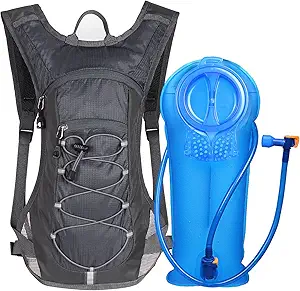 | Best Compact Pick | Bladder capacity: 2 liters | Bladder material: BPA-free | Pack material: 100% nylon | VIEW LATEST PRICE | See Our Full Breakdown |
| Osprey Raptor 10L Men’s Mountain Bike Hydration Pack, Gray |  | Best for Organized Trail Gear | Pack capacity: 10L | Reservoir included: Yes | Reservoir capacity: 2.5L | VIEW LATEST PRICE | See Our Full Breakdown |
| CamelBak M.U.L.E. 12 Mountain Bike Hydration Pack |  | Best for Long Day Rides | Capacity: 12 liters | Reservoir volume: 100 oz | Back panel: Air Support | VIEW LATEST PRICE | See Our Full Breakdown |
| Osprey Raptor 14L Men’s Mountain Biking Backpack with Hydraulics Reservoir |  | Best for Organized All-Day Riding | Capacity: 14 L | Reservoir included: Yes | Reservoir capacity: 2.5 L | VIEW LATEST PRICE | See Our Full Breakdown |
| CamelBak Hydrobak Hydration Reservoir Bike Pack |  | Best Compact Pick | Reservoir capacity: 50 oz | Design: Lightweight and compact | Back panel: Air mesh | VIEW LATEST PRICE | See Our Full Breakdown |
| mountain bike hydration pack | Harness | Reservoir capacity |
|---|---|---|
| CamelBak Classic Bike Hydratio | Ventilated | 85 oz |
| USWE Airborne Limited Race Edi | Patented bounce-free system | — |
| Teton Oasis/Trailrunner Hydrat | — | — |
| Unigear Hydration Pack Backpac | — | — |
| Osprey Raptor 10L Men’s Mounta | Winged harness | 2.5L |
| CamelBak M.U.L.E. 12 Mountain | — | — |
| Osprey Raptor 14L Men’s Mounta | Winged harness | 2.5 L |
| CamelBak Hydrobak Hydration Re | Ventilated | 50 oz |
More Details on Our Top Picks
CamelBak Classic Bike Hydration Pack
The CamelBak Classic suits riders who want a generous water supply without carrying a full gear bag. Its 85 oz Crux reservoir holds more water than the 2-liter bladder in the Unigear Hydration Pack, making it a stronger fit for longer rides between refills. The breathable air mesh and ventilated harness support airflow against your back, while reflective accents add visibility when a ride runs late. Storage is limited to a zippered pocket for small essentials, so I’d choose the Osprey Raptor 10L instead when tools, layers, and trail supplies need organized space. The Classic’s tradeoff is that it prioritizes water and a simple carry over gear capacity; the product details also don’t specify insulation for keeping water cool.
Pros:- 85 oz reservoir provides more water than the 2-liter Unigear bladder
- Breathable air mesh and ventilated harness support airflow
- Zippered pocket holds small ride essentials
- Reflective accents improve visibility in low light
Cons:- Limited storage space for larger items or extra layers
- No insulation is specified for keeping water cool
Best for: Trail riders who want a large water reservoir and only need to carry small essentials
Not ideal for: Riders carrying repair tools, extra layers, or substantial trail gear who need multiple storage compartments
- Reservoir capacity:85 oz
- Reservoir:Crux
- Material:Breathable air mesh
- Harness:Ventilated
- Storage:Zippered pocket for small essentials
- Visibility:Reflective accents
Our verdict“Choose the CamelBak Classic if water capacity and breathable comfort matter more than carrying room for trail gear.”
USWE Airborne Limited Race Edition Hydration Backpack with Water Bladder
The USWE Airborne Limited Race Edition is aimed at riders who want a pack to stay close and steady through hard efforts. Its bounce-free harness and 415 g pack weight (excluding the bladder) suit fast, technical rides where shifting cargo can distract. The 2-liter bladder is smaller than the CamelBak Classic’s 85 oz reservoir, but USWE provides 3 liters of total storage and multiple pockets and gear attachment points for a more purposeful race-day carry. That compact setup still limits room for bulky clothing or extensive trail supplies, so the Osprey Raptor 10L is a better match when organized gear capacity matters more than a low-profile fit. Sizing is specified for a 33–43.3-inch torso, which makes careful measurement part of choosing this pack.
Pros:- Bounce-free harness is designed to keep the pack stable during active riding
- 415 g pack weight excluding the bladder supports a lightweight carry
- 3 liters of storage with multiple pockets and gear attachment points
- 2-liter bladder is included
Cons:- Limited room for larger gear and bulky layers
- Torso fit range requires careful measurement
- 2-liter bladder holds less water than the CamelBak Classic’s 85 oz reservoir
Best for: Mountain bikers who ride fast or technical trails and want a low-profile pack with a stable harness
Not ideal for: Riders with torsos outside the listed 33–43.3-inch range or those carrying bulky gear
- Total storage capacity:3 liters
- Hydration bladder capacity:2 liters / 70 oz
- Pack weight:415 g, excluding bladder
- Torso sizing:33–43.3 inches (84–110 cm)
- Harness:Patented bounce-free system
- Storage features:Multiple pockets and gear attachment points
Our verdict“Pick the USWE Airborne if a stable, lightweight fit matters more than maximum water or cargo capacity.”
Teton Oasis/Trailrunner Hydration Backpack
Among these picks, the Teton Oasis/Trailrunner gives riders the most stated room for supplies, with 18L or 22L storage alongside a 2L bladder. That makes it better suited to all-day rides that involve extra clothing or more substantial gear than the compact Unigear Hydration Pack or the CamelBak Classic. A sewn-in rain cover, weather-guarded zippers, and a bungee cord system help protect and secure what you bring when conditions or trail surfaces change. The larger carry comes with a real fit tradeoff: the product details say it may not fit very tall or very small users well. Its bladder also needs regular cleaning to help prevent mold. This is a multi-activity pack with useful capacity, though its listed details are less specifically focused on bike fit than the Osprey Raptor 10L.
Pros:- 18L or 22L storage provides more gear room than the compact packs in this lineup
- Sewn-in rain cover and weather-guarded zippers help protect carried items
- Bungee cord system offers external storage
- Insulated bladder pocket is listed as helping keep water cold
Cons:- May fit very tall or very small users poorly
- Bladder requires regular cleaning to help prevent mold
- Larger storage capacity may be more pack than riders carrying only essentials need
Best for: Mountain bikers on long days who carry extra clothing, supplies, and gear alongside water
Not ideal for: Riders seeking a compact bike-specific pack or those whose height falls at the very tall or very small extremes
- Storage capacity:18L or 22L
- Water bladder:2L included; 2L/3L capacity listed
- Material:High-density foam and breathable mesh
- Weather protection:Sewn-in rain cover and weather-guarded zippers
- External storage:Bungee cord system
- Bladder pocket:Insulated
Our verdict“Choose the Teton if your mountain bike days call for carrying substantial gear and weather protection along with water.”
Unigear Hydration Pack Backpack with 2L Water Bladder
The Unigear Hydration Pack keeps the carry simple: a 2-liter bladder, a lightweight nylon pack, and adjustable shoulder, chest, and waist straps. Those three adjustment points help riders secure a compact load, while splash-resistant material offers some protection for belongings. It is a more stripped-down option than the Osprey Raptor 10L, which includes a larger 2.5L reservoir and multiple organizational compartments; choose Unigear when a bulky gear layout would go unused. Capacity is the main limitation for mountain biking: the front pocket is small, and the product details describe the pack as limited for longer outings requiring extra supplies. Some riders may also find its water flow slow. It suits short rides with a minimal kit, though the CamelBak Classic offers more reservoir capacity for riders who want to carry more water.
Pros:- Includes a 2-liter BPA-free bladder
- Shoulder, chest, and waist straps allow fit adjustment
- Nylon construction is described as splash-resistant
- Compact design suits a light carry
Cons:- Small front pocket limits storage for ride essentials
- Limited capacity for longer outings requiring more gear
- Water flow may feel slow to some users
Best for: Riders on short, light trail outings who want an adjustable pack for water and a few small items
Not ideal for: Riders on long rides who need a larger bladder, room for extra gear, or fast water flow
- Bladder capacity:2 liters
- Bladder material:BPA-free
- Pack material:100% nylon
- Weight:1.1 lbs
- Dimensions:16.5 × 8 × 6 inches
- Adjustable straps:Shoulder, chest, and waist
- Included components:Backpack and bladder
Our verdict“Pick the Unigear for short rides with a compact kit; choose the CamelBak Classic if carrying more water is the priority.”
Osprey Raptor 10L Men’s Mountain Bike Hydration Pack, Gray
The Osprey Raptor 10L is the gear-carry choice here: its 10L capacity and multiple compartments give trail tools and other supplies more structure than the single small pocket on the CamelBak Classic. A 2.5L reservoir also holds more than the 2-liter bladder in the USWE Airborne, while the winged harness, mesh hipbelt, and shoulder straps are designed for a secure mountain bike fit. That organization and bike-focused support make it a stronger match for all-day trail rides or bike park laps than either compact option. The tradeoff is a listed weight of 2.09 lbs, which may feel noticeable to riders trying to keep their load minimal. Its 10L capacity also sets a limit for outings that call for more gear than a day pack can hold.
Pros:- 10L capacity and multiple compartments organize trail gear
- Included 2.5L reservoir holds more than the USWE Airborne’s 2-liter bladder
- Winged harness is designed for a secure bike-specific fit
- Mesh hipbelt and shoulder straps support comfort
Cons:- Listed weight of 2.09 lbs may feel heavy to minimalist riders
- 10L capacity may be insufficient for rides requiring substantial extra gear
Best for: Men riding all day or doing bike park laps who want a stable fit and organized space for trail gear
Not ideal for: Minimalist riders sensitive to pack weight or riders who need more than 10L of gear capacity
- Pack capacity:10L
- Reservoir included:Yes
- Reservoir capacity:2.5L
- Dimensions:18.9 × 9.8 × 9.1 inches
- Item weight:2.09 lbs
- Harness:Winged harness
- Carry features:Mesh hipbelt and shoulder straps
Our verdict“Choose the Raptor 10L if organized storage and a bike-specific fit outweigh keeping pack weight low.”
CamelBak M.U.L.E. 12 Mountain Bike Hydration Pack
The CamelBak M.U.L.E. 12 suits riders who need water and room for trail essentials without moving to a much larger pack. Its 100 oz reservoir gives it more hydration capacity than the CamelBak Hydrobak, while the 12-liter pack adds tool organization, a stretch overflow pocket, and helmet carry for changing trail conditions. Air Support back-panel ventilation and magnetic tube management help keep the load comfortable and the hose accessible as the ride gets rough. Compared with the Osprey Raptor 14L, the M.U.L.E. has less stated storage capacity, but offers a removable waist strap and a dedicated overflow pocket. That makes it a practical choice for long single-day rides; its extra volume can feel bulky on quick spins, and the supplied details do not specify its weight.
Pros:- 100 oz reservoir supports longer stretches between refill stops
- Air Support back panel is designed to improve ventilation
- Tool organization and stretch overflow pocket suit changing trail needs
- Helmet carry and removable waist strap add carrying flexibility
Cons:- 12-liter capacity may be more pack than short rides require
- Weight is not provided in the product details
- Color options are not specified
Best for: Mountain bikers who take long day rides and want a large reservoir, organized tools, and space to carry a helmet.
Not ideal for: Riders who want a minimal pack for short loops or commutes, since the 12-liter capacity may feel bulky.
- Capacity:12 liters
- Reservoir volume:100 oz
- Back panel:Air Support
- Tube management:Magnetic
- Storage features:Tool organization and stretch overflow pocket
- Helmet carry:Included
- Waist strap:Removable
Our verdict“Choose the M.U.L.E. 12 for long single-day rides when hydration capacity and trail storage matter more than a compact carry.”
Osprey Raptor 14L Men’s Mountain Biking Backpack with Hydraulics Reservoir
The Osprey Raptor 14L is the storage-forward choice here for riders who want to carry trail essentials in a more organized layout. Its 14-liter capacity, multiple pockets, and tool roll give it more stated room than the CamelBak M.U.L.E. 12, while the included 2.5-liter reservoir keeps the hydration setup ready to ride. The winged harness and wrap hipbelt are built to hold the pack securely as the trail gets bumpy, a useful distinction from the compact CamelBak Hydrobak, which is aimed at shorter rides and carries far less gear. The tradeoff is a larger, heavier package: the listed weight is 2.22 pounds, and its dimensions may feel cumbersome to riders carrying only water and a few essentials. Its 14 liters fit day rides, not multi-day packing.
Pros:- 14-liter capacity provides more stated storage than the M.U.L.E. 12
- Included 2.5-liter reservoir is ready for hydration
- Winged harness and wrap hipbelt are designed for a secure fit
- Tool roll and multiple pockets help organize trail essentials
Cons:- Listed weight of 2.22 pounds adds to the load
- 14-liter capacity is not intended for multi-day packing
- Listed dimensions may feel bulky on shorter rides
Best for: Men who ride all day and want a stable harness, included reservoir, and separated storage for tools and trail gear.
Not ideal for: Riders seeking a light, compact pack for short rides, or anyone who needs capacity for multi-day trips.
- Capacity:14 L
- Reservoir included:Yes
- Reservoir capacity:2.5 L
- Dimensions:18.5 × 11 × 10.6 in
- Weight:2.22 lb
- Harness:Winged harness
- Hipbelt:Wrap hipbelt
- Organization:Tool roll and multiple pockets
Our verdict“Pick the Raptor 14L if stable, organized carrying for all-day mountain biking matters more than keeping pack weight and size down.”
CamelBak Hydrobak Hydration Reservoir Bike Pack
The CamelBak Hydrobak makes the most sense when a mountain bike ride calls for water and a few small essentials, rather than a full load of tools and layers. Its 50 oz reservoir and compact, lightweight design keep the carry pared down; the zippered pocket handles small items, while the air mesh back panel and ventilated harness are intended to help with airflow. Compared with the CamelBak M.U.L.E. 12, it gives up substantial hydration capacity and trail storage, so it is less suited to long rides or carrying a helmet. That limitation is also its advantage for commutes, training, and short loops where a 12-liter pack could feel excessive. The product details do not list a weight or pack capacity, and the limited storage rules out bulky gear.
Pros:- Compact design suits short rides and commutes
- 50 oz reservoir provides on-pack hydration
- Air mesh back panel and ventilated harness support airflow
- Zippered pocket secures small essentials
Cons:- Limited storage space cannot accommodate larger items
- 50 oz reservoir is smaller than the M.U.L.E. 12’s 100 oz reservoir
- Pack capacity and weight are not specified
Best for: Mountain bikers, commuters, and training riders who want a compact pack for water and a few small essentials.
Not ideal for: Riders heading out for long or gear-heavy trail days who need a larger reservoir, tool storage, or room for extra layers.
- Reservoir capacity:50 oz
- Design:Lightweight and compact
- Back panel:Air mesh
- Harness:Ventilated
- Pocket:Zippered pocket for small essentials
- Intended use:Short rides, commutes, and training
Our verdict“Choose the Hydrobak for short rides when a light, compact water carry matters more than room for trail gear.”
How We Picked
I evaluated each pack against the factors that actually decide whether a mountain bike hydration pack works on the trail: bounce-free stability on technical terrain, reservoir quality (filling, drying, leak resistance, hose routing), storage organization for tools, tubes, and layers, back ventilation, and overall durability for the price. Fit adjustability carried extra weight because a pack that shifts on descents is a safety issue, not just an annoyance.
The ranking logic follows ride use rather than raw specs. Packs that balance stability, storage, and comfort for typical two-to-four-hour rides rose to the top, which is why the CamelBak M.U.L.E. 12 leads. Larger-capacity packs like the Osprey Raptor 14 earned their place as all-day options rather than direct competitors, while minimal designs like the USWE Airborne were judged as race-specific tools. Budget packs were held to a fairer standard — judged on whether the savings cost you anything that matters mid-ride, not on missing premium features.
| mountain bike hydration pack | Harness |
|---|---|
| CamelBak Classic Bike Hydratio | Ventilated |
| USWE Airborne Limited Race Edi | Patented bounce-free system |
| Teton Oasis/Trailrunner Hydrat | — |
| Unigear Hydration Pack Backpac | — |
| Osprey Raptor 10L Men’s Mounta | Winged harness |
| CamelBak M.U.L.E. 12 Mountain | — |
| Osprey Raptor 14L Men’s Mounta | Winged harness |
| CamelBak Hydrobak Hydration Re | Ventilated |
Factors to Consider When Choosing Mountain Bike Hydration Packs
Before settling on a pack from the lineup above, it helps to understand how capacity, fit, and reservoir choices shape the day-to-day experience of riding with a pack on your back. These are the factors that separate a pack you forget about from one you fight with every ride.Match Capacity to Your Actual Ride Length
The most common mistake buyers make is choosing capacity for the biggest ride they might someday do, then carrying a bulky half-empty pack on every normal ride. As a rough guide, a slim 6-to-9L pack covers one-to-two-hour rides with a tube, multi-tool, and snack; a 10-to-12L pack handles most trail days; and 14L-plus is for all-day missions where you’re carrying layers, food, and repair gear. Note that capacity includes the reservoir — a “12L” pack with a 3L bladder leaves you 9L of cargo space, not 12L. A too-large pack bounces more, traps heat, and shifts your center of gravity on descents, which is a genuine handling penalty. When in doubt, buy for your typical ride and stash a spare bottle or stop to refill on the rare epic.
Harness Design Determines Stability
On rough terrain, the harness matters more than anything else in the design. Traditional shoulder-strap packs with a sternum strap work well up to a point, but they need careful strap tensioning to stop sway on drops and rock gardens. Vest-style and no-dance harnesses — like the USWE approach — wrap the torso and essentially eliminate bounce, at the cost of more contact area and heat. Hip belts transfer weight off your shoulders but add bulk and can interfere with baggy shorts waistbands. If your riding is mostly flowy singletrack, a conventional harness is fine; if you ride aggressive descents or enduro terrain, prioritize a pack that locks down, even if it runs warmer. Try to load any pack with the water weight it will actually carry when judging fit, because an empty pack on a shop floor tells you almost nothing.
The Reservoir Is Half the Product
Buyers often fixate on the pack and overlook the bladder, but the reservoir shapes your daily experience more than almost any other component. Wide-mouth openings make filling and drying dramatically easier — a narrow-mouth bladder that never fully dries will eventually grow mold you can’t clean out. Look for a magnetic or secure hose catch so the bite valve isn’t flapping against your chest on descents, and a slide-top closure rather than a screw cap, which is faster to refill mid-ride. Reservoir quality is also where budget packs cut corners: the included bladders in cheaper packs often work but are stiff, awkward to dry, and prone to tasting plastic for the first dozen rides. The good news is that reservoirs are replaceable, so a great-fitting budget pack can be upgraded later with a better bladder rather than replacing the whole system.
Ventilation and Back Comfort in Warm Weather
A soaked, overheated back is the most common complaint among riders new to hydration packs, and it’s a design tradeoff rather than a flaw. Packs with suspended mesh back panels let air circulate and keep you drier, but they sit slightly farther from your spine and can sway more. Packs that hug the back closely ride the most stable but trap heat directly against your body. In hot climates, ventilation deserves a higher priority than in cool alpine conditions where the extra contact is a non-issue. Some riders solve this entirely by moving to a bottle cage plus a slim pack, which works if your frame fits a bottle and your rides have refill options. Also check padding placement — channels between foam pads make a real difference on multi-hour rides, while solid foam slabs become uncomfortable quickly.
Organization: Tools You Can Reach Without Dismounting
Trailside repairs happen when you’re tired and mid-ride, so pocket layout is a real performance feature, not a luxury. The best packs put a multi-tool, snacks, and your phone in pockets reachable while wearing the pack, so you can fix a chain without fully dismounting. Bigger main compartments are fine for layers and pumps, but anything you might need in a hurry belongs in a hip pocket or side access. Roll-out tool organizers — like CamelBak’s magnetic versions — keep small parts from migrating to the bottom of the bag where you can’t find them. Beware of packs that advertise many pockets without logical placement: ten poorly positioned pockets are worse than four well-placed ones. If you ride with tubeless repair kits, check that at least one pocket closes securely, because plugs and valves escape open mesh pockets on the first descent.
Durability and the Real Cost of Cheaping Out
Hydration packs take abuse: crashes, branches, mud, and being thrown in the car wet. Fabric denier, zippers, and strap stitching are where cheap packs fail first — a blown zipper on a main compartment effectively ends the pack’s useful life even if the fabric survives. That said, overspending on a bombproof pack for gentle weekend rides is its own mistake. A reasonable rule is that the more technical your terrain and the more you crash, the more build quality should drive your budget. Also factor in replaceable parts: buckles, bladders, and bite valves wear out on every pack eventually, and brands with easy spare-part availability extend the life of your investment considerably. A mid-range pack from a brand that supports replacement parts often outlasts two budget packs, which changes the actual value math.
Frequently Asked Questions
Is a hydration pack better than water bottles for mountain biking?
It depends on your terrain and frame. A hydration pack wins when you ride technical descents where reaching for a bottle is risky, when your frame can’t fit a bottle cage, or when you’re out long enough to need tools, a layer, and food alongside your water. Bottles win on ventilation — your back stays far cooler and drier — and they’re easier to clean. Many riders end up using both: a bottle or two for hot-weather flow rides, and a pack for big backcountry days or aggressive terrain. If you’re choosing your first system, a modestly sized pack like the CamelBak Hydrobak covers short rides cheaply and leaves room to add bottles later.
What size hydration pack do I need for mountain biking?
For most riders, 9-to-12 liters is the sweet spot: enough for a 2-to-3L reservoir plus a tube, tools, a layer, and food, without excess bulk that bounces on descents. That’s exactly why the M.U.L.E. 12 and Raptor 10 sit at the top of this roundup — they match the length of a typical trail day. Go smaller (5-to-8L) only for short, fast rides where you’re certain you won’t need layers, and go to 14L-plus for all-day rides, bikepacking-adjacent missions, or riding with kids where you end up carrying everyone else’s gear. Remember that reservoir volume counts inside that number, so a 12L pack with a 3L bladder gives you roughly 9L of cargo space. Buying slightly small and pairing it with a frame bottle is usually better than buying large and riding with a floppy half-empty pack.
How do I stop my hydration pack from bouncing on descents?
Start with fit mechanics before blaming the pack: the shoulder straps should be snug but not cutting, the sternum strap should sit roughly two inches below your collarbones, and — on packs that have one — the hip belt should carry some of the load so the pack doesn’t pendulum from your shoulders. Load heavy items close to your spine rather than at the outer face, because weight hanging away from your back amplifies sway. If you’ve dialed all that and the pack still moves on rough trails, the design itself is the limit — that’s where vest-style harnesses like the USWE Airborne make sense, since they wrap the torso and basically eliminate bounce. The tradeoff is more contact area and heat, so it’s a stability-first choice rather than an upgrade for everyone.
How do I keep my hydration bladder from getting moldy?
The key is drying, not cleaning — mold grows in bladders that are stored with residual moisture. After every ride, empty the bladder, rinse it, and hang it wide open to air dry; a wire bladder dryer or even a couple of chopsticks propping the opening open speeds this up massively. Freeze the bladder between rides if you use it weekly, since mold can’t grow in a freezer. For cleaning, denture-cleaning tablets or a baking-soda solution work well every few weeks, and a small brush handles the drink tube. Wide-mouth and slide-top bladders — like the CamelBak and Osprey reservoirs in this lineup — dry far more easily than the narrow screw-cap bladders in budget packs, which is a genuine long-term hygiene argument for spending a bit more.
Can I use a hiking hydration pack for mountain biking?
You can, but you’ll notice the differences within a few rides. Hiking-oriented packs like the Teton in this roundup prioritize cargo capacity and load-hauling over stability at speed, so they tend to bounce more on descents and sit lower on your back where a bike posture wants the load high and tight. They also usually lack bike-specific organization — a fleece-lined pocket for sunglasses, tool rollout, helmet carry, and tube-securing straps. Where hiking packs genuinely work well is long gravel or fire-road riding at moderate pace, where the extra capacity and rain cover earn their keep. If most of your riding involves actual singletrack, a bike-specific pack will fit and ride noticeably better, and the Teton-style packs are better saved for dual-use buyers who hike as much as they ride.
Conclusion
The right pick here depends less on which pack is objectively best and more on how you ride. For the best overall choice, the CamelBak M.U.L.E. 12 earns it: stable on descents, genuinely useful tool organization, and a reservoir system that’s easy to live with — the most complete package for typical trail days. For best value, the Teton Trailrunner delivers remarkable capacity plus a rain cover at a budget-friendly price, provided you accept a heavier, less refined ride and a mediocre bladder. On the premium end, the Osprey Raptor 14 justifies the spend for all-day riders who want superior build, fit, and back-panel ventilation, while the USWE Airborne is the premium pick specifically for racing and aggressive descending where its bounce-free harness is unmatched.
For beginners and short-ride riders, the CamelBak Hydrobak is the easiest entry point — simple, light, and hard to get wrong — with the Unigear serving budget-first buyers who want more storage for occasional use. Finally, for a specific need: the Osprey Raptor 14 for all-day capacity, and the CamelBak Classic as a solid do-it-all middleweight if the M.U.L.E. feels like more than your rides demand. Buy for the rides you actually do, and any of these will serve you well.
NFL season / tailgating Picks
team gear
As an affiliate, we earn on qualifying purchases.