
TL;DR

Get sports gear delivered free with Prime
- Fast, free delivery on millions of items
- Prime Video, Amazon Music and more included
- Member-only deals all year
Outdoor Life published a practical guide on Oct. 28, 2026, explaining how bowhunters can sharpen and hone different broadhead designs. Its central method is to match the existing bevel, raise and remove a burr with progressively finer abrasives, and use cut-resistant gloves if inexperienced. The guide is instructional, not a report of a new product or official safety rule.
Outdoor Life published a guide on Oct. 28, 2026, explaining how bowhunters can sharpen or hone broadheads using stones, fixed-angle systems or belt sharpeners. The report by Drew Conover covers several head designs and stresses matching the existing edge angle, controlling the blade safely and distinguishing sharpening from honing.
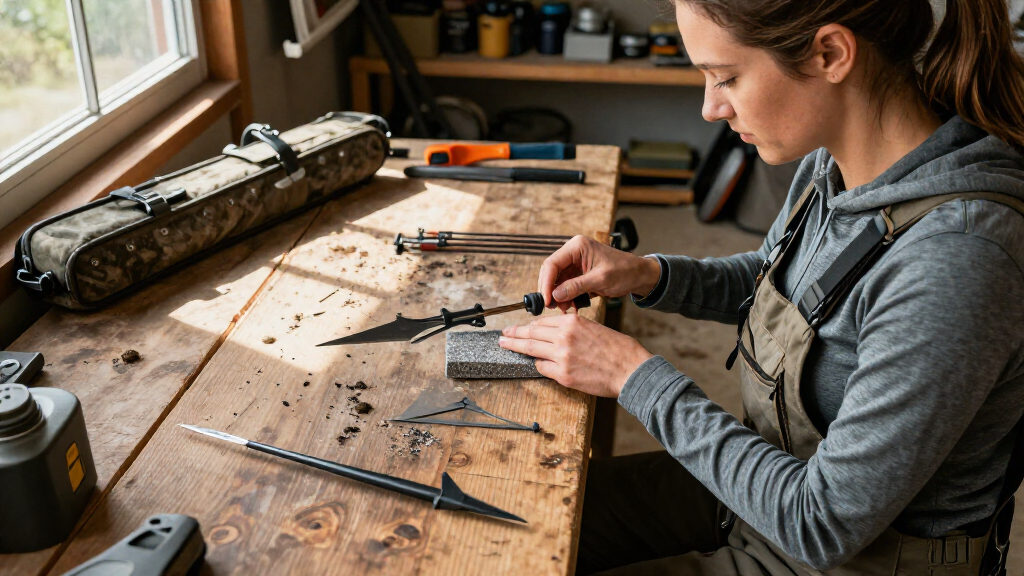
The guide’s basic sharpening sequence is to color the bevel with a permanent marker, adjust the sharpening angle until the marker is removed evenly, and use light pressure to work the edge. The sharpener should remove enough metal to raise a small burr at the edge, then repeat the process on the opposite side. The report recommends moving to finer grit and continuing until the burr can no longer be felt.
A two-sided stone or dual-grit diamond stone can address damage with its coarse side and refine the edge with its finer side. A leather strop and compound are optional for polishing. Conover also describes a belt sharpener as a faster option for fixed and replaceable-blade heads; he says it creates a slight convex edge. A fixed-angle sharpener can help users hold a consistent angle, while a small stone is easier to carry in the field.
For handling, the report suggests mounting a broadhead on an old arrow cut to about eight inches to provide a grip. Conover recommends that people new to sharpening wear thin leather or cut-resistant gloves, since holding the head by a blade can expose fingers to cuts. The guide says lightly dulled edges may need honing rather than sharpening: honing polishes or realigns an existing edge, while sharpening removes metal.
Edge Care and Safe Handling
Broadheads are cutting tools used in bowhunting, so a consistent edge and careful handling matter to both equipment preparation and personal safety. The guide presents sharpness as one factor in responsible hunting, while also stressing that shot placement remains important. Its techniques give readers a way to check and maintain an edge rather than assume a new or lightly used head needs substantial metal removal.
The advice is practical, but it is not a substitute for safe handling or hunting instruction. Broadhead models and edge geometries differ, and the article’s method of matching the existing bevel is intended to preserve that geometry. Readers should follow the head maker’s instructions where available and avoid testing sharpness in ways that put fingers in the blade’s path.
Products Worth Considering

Solo Stove Bonfire 2.0 Smokeless Wood-Burning Fire Pit with Stand, Silver

Theragun Mini 3rd Generation Massage Gun – Travel Essential (Black)

YETI Trailhead Collapsible Camp Chair
As an affiliate, we earn on qualifying purchases.
The Outdoor Life report applies its general method to fixed two-blade, single-bevel, three-blade, mechanical and replaceable-blade broadheads. It names a range of possible equipment, including stones, ceramic rods, strops and powered belt sharpeners. The recommendations are presented as the author’s practical guidance and gear choices, not as a formal standard or universal manufacturer specification.
Conover describes a lesson from a bowhunter safety course in which instructors used rubber bands to illustrate the difference between sharp and dull heads. That experience informs his view that edge condition matters alongside shot placement. For a head that is still relatively sharp, the article recommends honing rather than sharpening; it lists a ceramic rod, strop and certain smooth surfaces as possible honing tools, with light pressure and alternating sides.
““Match the Angle.””
— Drew Conover, Outdoor Life
Model-Specific Details Still Matter
The source material does not provide a separate manufacturer’s specification for every broadhead model, nor does it establish one correct angle or grit sequence for all designs. It identifies several categories of heads, but the supplied report text does not include the full step-by-step instructions for each category. The best method may depend on the head’s construction and the maker’s guidance.
The article is an individual gear-and-technique report, not a controlled comparison of sharpening systems. It does not provide measured performance data comparing the named tools, or independent evidence for the author’s characterization of particular edges. Readers should treat product recommendations as the author’s selections and verify compatibility with their own broadheads.
Check the Edge Before Use
Bowhunters following the guide should first inspect the head and determine whether it needs light honing or more substantial sharpening. If sharpening is needed, the suggested next steps are to secure the head safely, mark the bevel, match its angle, work from coarser to finer abrasive, and remove the burr before optional stropping. Beginners can practice on suitable equipment before handling a broadhead and should use protective gloves.
The report does not announce a forthcoming product, rule or follow-up study. The practical next step for readers is to consult the broadhead manufacturer’s care instructions and confirm the edge is prepared before taking equipment into the field.
Key Questions
What is the basic method for sharpening a broadhead?
Match the existing bevel, use light pressure to raise a burr, repeat on the other side, then move to finer grit until the burr is gone. Stropping is optional.
When should I hone instead of sharpen?
According to the Outdoor Life guide, a head that is new or still relatively sharp may only need honing. The report describes honing as polishing or realigning the edge without removing steel.
What equipment can sharpen broadheads?
The guide discusses two-sided stones, diamond stones, fixed-angle systems and belt sharpeners. A leather strop can be used afterward to polish the edge.
How can I reduce the risk of cutting myself?
Conover recommends that beginners wear thin leather or cut-resistant gloves. He also suggests using a short piece of old arrow as a handle to improve control, especially with a belt sharpener.
Source: rss